

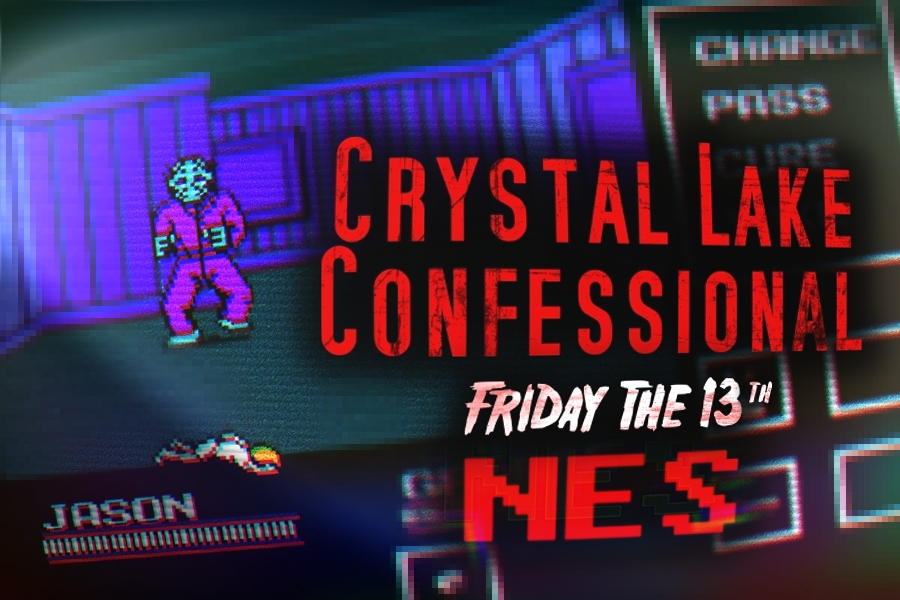

For those who haven’t watched the Friday The 13th films, this article contains spoilers.
Jason Voorhees is one of the most enduring figures in horror. Whether you love or hate the franchise, you can’t deny its impact on popular culture. Often overlooked is what went into making the 12-film series. Through extensive research and interviews, I invite you to take a closer look at the Friday The 13th universe. This is Crystal Lake Confessional.
As a kid born in the 1980s, I was privileged to experience quite a few nexus events in pop culture. Watching a new Friday The 13th film for the first time certainly was one, and getting a Nintendo Entertainment System (NES) for Christmas was another. Even more exhilarating? The combination of the two.
In early 1989, American toy company and video game publisher LJN released Friday The 13th on the NES.
Why would a toy company release a video game based on an already infamous, R-rated slasher franchise to children? The reason was simple. It was the ’80s, and kids loved video games and horror movies. So adapting such a franchise was the trifecta of capitalism. But how did Jason fare on his video game debut? Let’s take a closer look at Friday The 13th NES!
Founded in 1970 by Jack Friedman, LJN dreamed of Mattel and Milton Bradley money. After minor success with various tie-ins, Friedman realized it was easier to license television shows and movies for toys than it was to create brand-new IPs. This idea paid off in 1982 when the company released a toy line based on Steven Spielberg’s E.T. the Extra-Terrestrial. Without a single penny spent on advertising, the line sold upwards of $25 million dollars. Combining this feat with a successful toy lines for the WWF, ThunderCats, and Brooke Shields (of all things), LJN became a direct competitor to the traditional merchandise juggernauts.

Setting their sights on the bigger picture, LJN used the same licensing tactic to enter the then-growing trend of video games. Hiring outside developers Atlus, Rare, and Beam Software, LJN began publishing video games based on films such as Back To The Future, The Karate Kid, and Jaws. Despite these IP tie-in games receiving less-than-stellar reviews, they sold extremely well. Hence, they became a lucrative business for LJN as the decade came to a close. One such videogame would be based on the Friday The 13th franchise, and it would effectively bring various elements of horror to the living rooms of kids across the country.
The problem? LJN was no Capcom or Konami.
As any gamer of the era could tell you, LJN games had, shall we say, a distinctive feel about them. Not always side-scrollers, platformers, or quests for a high score, LJN games often featured big swings of high concepts meant to set them apart from what traditional first-party developers were releasing. While some of those swings displayed broad strokes of ambition, most of them felt like the company rushing out a product to coincide with the release of a film. The games were notorious for weird gameplay mechanics, stiff controls, and sometimes just bizarre aesthetics.
In Friday The 13th NES, the primary goal was to defeat Jason multiple times over the course of three days at Camp Crystal Lake. You also had to protect a group of children and your fellow counselors. To achieve this, you played as your choice of six camp counselors: George, Crissy, Mark, Laura, Paul, and Debbie.
Mind you, None of these characters were based on anyone from any of the films. What set them apart from each other were varying levels of running, jumping, and strength. George can row the boat faster than anyone but is a terrible runner. Laura can jump high but takes damage easily. This added some much-needed flavor to the characters and gameplay by encouraging the player to build their own personal strategy.

The map was simple by design but much more complicated in practice.
Along the paths are various cabins, caves, the woods, and the lake itself. Players had to fight against zombies, wolves, and crows. They also needed to upgrade their weapon arsenal and locate Jason Voorhees before he kills anyone.
The game operated on a traditional side-scrolling template where your character is free to roam about the entire map and its locations. Periodically, a buzzer and timer would sound, signifying that Jason is attacking either a kid or a counselor in a cabin. The player must then reach the cabin to rescue the victim and fight Jason.
Entering the cabin changed the perspective to a pseudo-3D view behind the counselor. The player must navigate the cabin and stumble across Jason to trigger the battle. During the battle, Jason moves about the screen, attacking the player randomly. In addition to retaliating, the player can move left and right and duck to avoid Jason’s attacks. If Jason kills all the counselors or all the children, the game is over.
Exploring mostly meant buffing your inventory with stronger weapons and health vitamins.
But curiosity had its price. Wander too long in the caves, and you could stumble straight into Jason’s shrine to his dead mother. Stumbling into the shrine means an unexpected boss battle against Pamela Voorhees’s disembodied head. Yes, it was exactly as weird and oddly horrifying as that sounds.

Due to a lack of credits in those days, we don’t know much about the making of Friday The 13th.
We know the game was developed by Atlus and supervised by founder, Hideyuki Yokoyama. Difficult games meant consumers would feel like they were getting their money’s worth. That encouraged them to purchase the game to spend more time with it as opposed to renting it. It was good capitalism for its time.
A junior tester at Atlus during development, Ryutaro Ito (who’d later become a planner on the Shin Megami Tensei series), remembered the game fondly decades later. But he also remembered struggling to get through it himself during testing. According to Ito, that punishing difficulty of Friday The 13th NES was a standing directive for any NES title bound for American shelves.
Unfortunately, Friday The 13th NES wasn’t just difficult; it was cryptic. Outside of a short cutscene at the beginning with vague instructions, the player has no idea what the objective is or where to go. Instead, you’re thrust into the map armed with only a rock, the buzzer already going off, and controls that never quite feel as responsive as the moment demands. This led many players to instant frustration rather than an enjoyable experience. There was no internet in those days. It could take hours, if not the entire rental period, just to figure out how to play the game properly.
It didn’t help that the Jason model was a little strange in the color department.
Aside from the vague gameplay and difficulty, Friday The 13th NES has an interesting visual and audio aesthetic. While not graphically groundbreaking, the sprites, background, and animation do their job well. Locations look exactly like what they’re trying to convey, and the character design fits the aesthetic.
However, developers based the appearance of Jason on the Japan-released Friday The 13th Part 3 poster. In that design, Jason is covered in shadow and blue light. In the game, it translates to a purple jumpsuit and turquoise mask. That may be silly now, but back then, using one’s imagination to accept artistic liberties was common practice.

Soundwise, there were only two main themes. The overworld map had upbeat drive, and the cabin scenes featured an ominous and somewhat emotional theme. Along with the aforementioned attack buzzer and orchestral stings when Jason appears, the game did a fantastic job of building tension. In fact, that tension might be one of the most interesting elements of the entire experience.
The Jason in Friday The 13th NES could even be considered more ruthless than the film version.
Specifically, he killed children, something that hadn’t happened in the movies. It may be hard to imagine, but when this game was released, there weren’t many horror games on the NES. Sure, Castlevania and Ghosts ‘n Goblins were part of most gamers’ repertoire, but those games put a stronger emphasis on adventure and action. Friday The 13th NES was very much set in the world of the films.

While there wasn’t a single drop of blood to be found in the game, I remember being at my wit’s end when that buzzer sounded. I was a kid, just trying to figure out what to do, only to have Jason pop up on the screen and take me out with just a few hits. Even worse, when you’re aware he’s in the cabin, you were forced to explore rooms looking for him. This combination of stress, existential dread, and confusion made for an effective horror-related experience on the console!
After a relatively short development, Friday The 13th NES was released in February 1989.
That’s nine months after Friday The 13th Part VII: The New Blood was released in theaters and five months before Friday The 13th Part VIII: Jason Takes Manhattan. Those were the two worst-reviewed and poorest-selling installments of the film franchise up to that point. Also, by 1989, the slasher genre itself had lost most of its cultural momentum. That made the IP a tough sell to both gamers and horror fans alike.
As with the films, the critics were not gentle.
GamePro later ranked it the tenth worst movie-licensed game ever made, singling out its “repetitive music score and amazingly frustrating gameplay.” Nintendo Power went further, placing it sixth on their list of the worst games ever made in 1997. One writer admitted that after a few minutes of play, you found yourself rooting for Jason to just kill everyone and put you both out of your misery.
It wasn’t until the YouTube era that the game would finally garner something of a cult following. Thanks to the Angry Video Game Nerd’s 2006 review, the game was introduced to a new generation who not only loved retro video games but took great delight in redeeming the proverbial bad ones.

The rehabilitation didn’t stop at YouTube. In 2013, NECA released a video game-style Jason figure using the cartridge’s turquoise-and-purple color scheme. Later, when Gun Media’s own Friday The 13th: The Game launched in 2017, developers added a “Retro Jason” skin modeled on this exact 8-bit design. It was an explicit apology to fans of the original for how much that game’s own launch struggled. The joke had officially become canon.
Just like the legacy of the franchise, Friday The 13th NES transcends sales, critiques, and infamy by being an anomaly.
It’s a film series based on the simplest of horror values, created for the sole purpose of capital. Yet it somehow endears itself to a specific audience. It’s an audience that recognizes its flaws, makes no excuses for them, but loves the product anyway. There’s an odd sense of liberation in that feeling. Bad as it was, it refused to stay dead. Fitting, for a game about a guy who can’t either.
Catch up with previous installments of Crystal Lake Confessional here.