

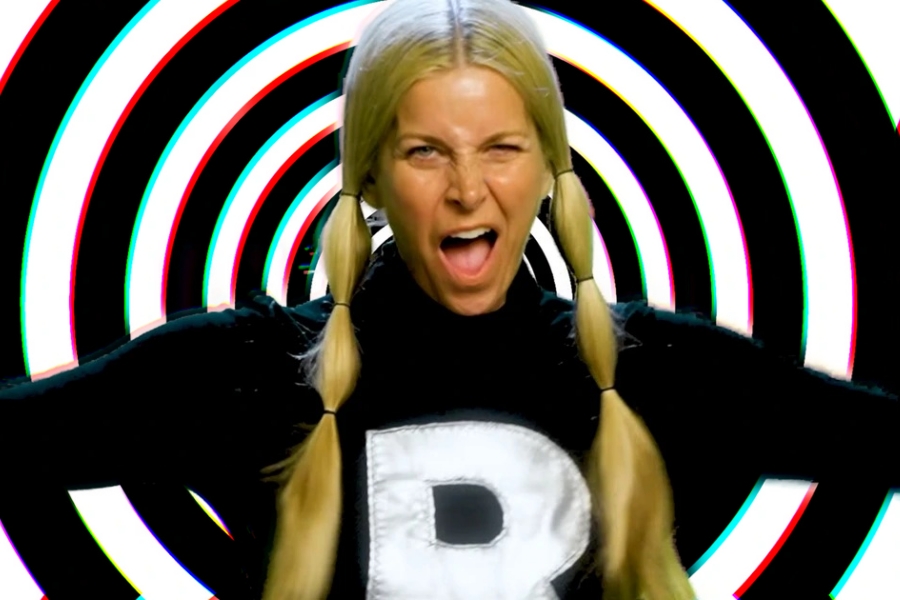

Well, seeing as Sheri Moon Zombie has shown up in every single project created by her husband, Rob Zombie, her own foray into music was more than inevitable. Enter “I Love My Robot,” her Chris “Zeuss” Harris-produced debut single, complete with a music video directed by, you guessed it, Rob Zombie himself.
“AI. AI. I don’t need your AI.”
She stomps through the hook in an aggressively upbeat chant, like some sort of Gen Z mom mocking a cheerleader. Arriving on picture-disc vinyl paired with a B-side from Rob, the public premiere has been billed as a multimedia event with “an army of robots.” On paper, it’s a campy, retro sci-fi anthem about resisting an algorithm-driven world, and it’s obviously anti-AI. And I love that message! I’ve written before about how strongly I feel about artificial intelligence having no place in music. So I really wanted to like this song.
But I don’t. Not at all. Though, that’s not really the discussion I want to have. The problem is that the song seems to know it’s not good. It’s actively banking on that knowledge to make any criticism of the art feel beside the point.
You can’t critique a song that’s already in on its own joke.
“I Love My Robot” is beyond bad. The video is smarmy, cringe, and tongue-in-cheek to the point of self-parody and entirely intentional. Regardless of whether you call it “playful camp” or “B-movie charm” (which is what publicists call it when nobody involved wants to say the word “corny” out loud), it raises some uncomfortable questions. If a song is bad, and it’s supposed to be bad, and the artist is actively leaning into how bad it is, can you even critique it at all? You can call it what you want, but it comes with a built-in response: “That’s the point.” You’ve been out-flanked before you even put pen to paper.

Sheri Moon Zombie has effectively weaponized self-awareness.
When an artist gets ahead of any criticism by admitting the flaws first, they turn any hint of “This is bad” criticism from an insult into a shrug. It’s a pretty cool trick when you think about it. But it’s also a little unfair. Artists should absolutely be allowed to be campy or silly. This is different: it preemptively tries to make quality an off-limits conversation.
To be clear, Moon hasn’t done anything revelatory. Irony as immunity isn’t a new move. Leaning into badness on purpose has a long, legitimate history in pop culture. William Hung built an entire career on being a terrible singer. Tenacious D have spent decades being gloriously ridiculous. Corey Feldman’s attempt at music has been mocked for years, and at some point, the mockery became part of the product.
Rob Zombie himself has made a name for himself by thriving on ’60s grindhouse camp in both his music and films. Even an artist such as Weird Al has made a genuinely brilliant career out of being the joke on purpose. He’s living proof of how this move can work exceptionally well when the craft underneath the comedy is airtight. I, for one, love trash as long as it knows what it is and understands the responsibility.
“So bad it’s good” isn’t the issue.
The issue is what’s different. This isn’t a novelty act built entirely on the bit, nor does it have the songwriting chops holding it up underneath. Moon’s debut single uses irony as a shield to deliver a message the artist says she allegedly believes in. It’s that combination where “I Love My Robot” sees things getting a little murkier.
I want to be careful. I am not questioning whether or not Sheri Moon Zombie has the right to make an anti-AI, pro-authenticity argument. She does. Everyone does. But it’s fair to look at the vehicle the argument arrives in and ask whether it undercuts itself. The head start is real, but it’s also not a moral failing. Plenty of artists get one from connections, and having resources doesn’t make anyone’s music illegitimate.

The Strokes’ Julian Casablancas grew up the son of a modeling agency mogul. Wolfgang Van Halen and Violet Grohl, respectively, carry famous last names into rooms most musicians never get into. Gracie Abrams’ father is a major film director and Hollywood darling. And of course, Taylor Swift’s family had the means to relocate and invest in a label deal that gave her a multi-million-dollar contract before she’d released a single mainstream song. Absolutely none of that erases their talent or work ethic. But it’s also not nothing.
Access changes what’s possible in ways most working musicians will never experience.
The reason this discussion of access matters here specifically is that the song tries to make an argument about authenticity and human connection mattering more than algorithmic shortcuts. Yet, it arrives through one of the more resourced, low-risk paths an artist can take. It feels like it’s saying, “I used my connections to make this happen.” While nepotism doesn’t invalidate the message, there’s still very little on the line for Sheri Moon Zombie and her music career.
One thing worth flagging here, because it cuts the other way: Women artists get their authenticity questioned far more often and far more aggressively than men do. I’m not interested in adding to that dogpile by suggesting that Moon somehow isn’t qualified to speak on this topic. She is. Full stop. The point isn’t her legitimacy. It’s whether this particular song, in this particular package, has earned immunity from criticism, even though it’s pointing its finger at a very real issue.
If the song is armored against being judged on craft, who is this actually for?
My first thought? It’s not really aimed at listeners in the traditional sense of asking to be liked or evaluated. I mean, any rock ‘n’ roll playing it safe is gonna suck. So, maybe it’s aimed at an audience who’s already bought into the aesthetic and the bit. Between the vinyl, the robots, or the B-side, the experience itself is the product. In that case, the song becomes the delivery mechanism for brand extension. Which means that, if it’s really just a wink for the already-converted, the song was never built to survive outside criticism.

That is a legitimate artistic statement, but it’s different than making a serious statement about AI. No matter how much camp or commentary is stuffed inside this song and its trappings, it’s tough to be both at once. Moon’s attempt to create a campy shield from criticism doesn’t really work, because here we are.
The message of “I Love My Robot” effectively undermines itself.
Here’s what bothers me the most. One of the central arguments against AI is that the music it produces is hollow and empty. It’s assembled rather than felt. AI music is more concerned with nailing a formula rather than saying anything meaningful or real. That’s a serious critique and one worthy of passionate belief.
So what happens when a purported vehicle for defending human creativity against digital hollowness is a song that leans so hard into “This doesn’t have to be good, it’s a bit” that its own quality becomes a non-issue? The song has adopted the exact posture it argues against. It may be making fun of soulless, disposable content, but it feels like content that has opted out of being taken seriously. Different excuse, same outcome.

If AI music is bad because nobody has to try, how is a song that also isn’t trying supposed to be the rebuttal?
Comedy can absolutely carry a serious argument, but it has to land the joke. The humor in “I Love My Robot” is goofy, not pointed, and a joke that doesn’t land takes the whole argument down with it.
“I Love My Robot” wants to tell you that human creativity and connection can’t be replaced. I agree with that message wholeheartedly. AI is a terrible invention. It’s ruining careers, artistry, integrity, and the environment. Sheri Moon Zombie probably feels the same way. But any song that treats its own quality as optional is not making a strong case. Because at that point, the proverbial human touch can no longer separate the art from what it’s allegedly criticizing.
This probably won’t be the last song to use self-awareness as a shield. When it happens again, we should still be allowed to call it what it is. As for “I Love My Robot”? Being in on the joke doesn’t make it a good one.
For my thoughts on AI being used in music, please check out Faking The Feeling | The Empty Promise of AI Music