

For anyone who grew up in the ’80s and ’90s, the VHS rental and cable boom was a revolution. This was especially true for the horror genre. You could stay up late watching Tales From the Crypt on HBO. Or you could hunt through video store shelves of body horror and supernatural dread for the perfect B-movie. Everything was an experience. More often than not, this horror smorgasbord allowed fans to mix multiple genres and get more bang for their buck. Science fiction, psychological thrillers, and drama paired well with horror.
But what about comedy? Does comedy ruin horror? It depends on three specific elements: Whether the monster stays dangerous, whether the audience gets room to exhale, and whether the humor knows what it is allowed to touch.
The real difference between comedy and horror comes down to craft and taste.
Tobe Hooper’s The Texas Chainsaw Massacre 2 (1986) is a strong cautionary case, though it is more complicated than it first appears. The 1974 original is dark, miserable, and genuinely terrifying. There was no honest way to follow it. Hooper didn’t want to make a sequel at all, so he made one that mocked the very idea. He leaned into broad satire, essentially poking fun at the audience’s appetite for more.
Leatherface and his family remain visually horrifying, but the film constantly invites you to laugh at them. The character Stretch even survives in part by being polite, which the movie treats as a gag. As a critique of the genre, this choice was deliberate and even smart. As actual horror, the cost is devastating. Once the audience believes a character can talk their way out of being murdered, the threat vanishes.

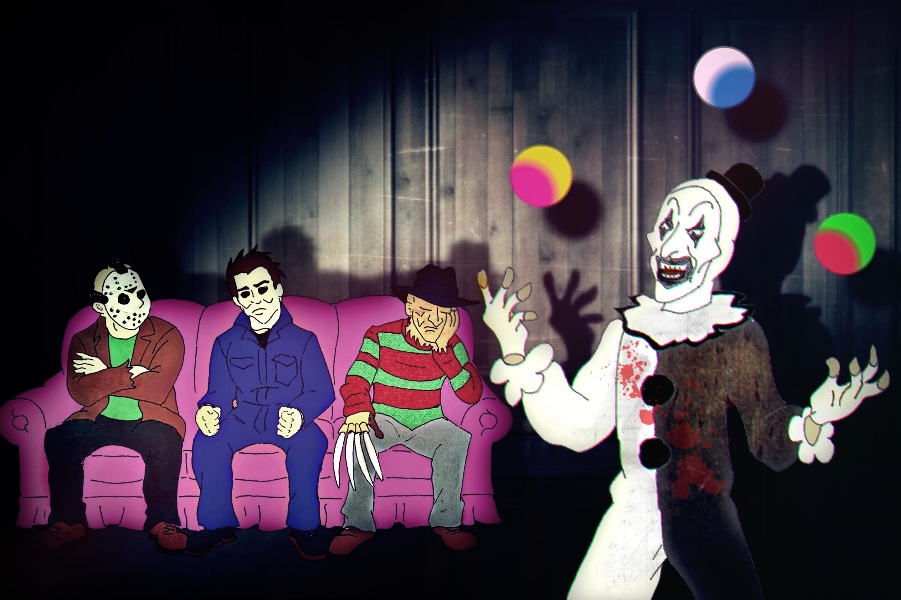
The iconic slasher franchises show the same erosion over time, though entirely by accident. Freddy Krueger began in 1984 as a genuinely frightening dream demon. By the later sequels, he had transformed into a pop-culture comedian like a nightmarish Bugs Bunny, delivering one-liners before every kill. Jason Voorhees followed a similar path, with audiences eventually rooting for him to slaughter an increasingly annoying cast.
Friday the 13th Part VI: Jason Lives (1986) is the instructive exception to this rule.
Thanks to writer and director Tom McLoughlin, the film is openly self-aware. It opens with a James Bond-style gun-barrel sequence. It sends a group of paintball-playing corporate types, bantering and oblivious, right into Jason’s path. The jokes belong strictly to the film’s world and to the victims’ dialogue.
Jason himself stays a silent, brutal force of nature. Every kill is played entirely straight. That idea introduces the primary rule I would create for adding comedy to horror. The world around the monster can be funny, but the monster has to stay deadly serious.

Scream is the absolute model for that rule. Its humor is meta and self-aware. The audience shares the film’s opinions about the genre. Because of this, the jokes feel like a conversation rather than a cheap spoof. But the stakes stay entirely real.
People die, and most of them die because they fail to realize the killer is using horror movie tropes against them. The satire belongs to the world, and Ghostface stays dangerous. Halloween H20 (1998) borrowed that exact energy. It made its characters relatable without making Michael Myers any less menacing.
Only the world around the monster should be funny.
Dan O’Bannon’s The Return of the Living Dead (1985) applies this rule perfectly. I first saw it at five or six years old. At the time, it registered as a pure nightmare of fast, brain-hungry corpses. A few years later, I noticed its goofy punk eccentricity. As an adult, I see what it really is: a meticulously written dark comedy. The laughs come organically from characters reacting with logical, panicked hysteria to an impossible situation. The humor never mocks the horror. It coexists with it, which is why the bleak, nihilistic ending hits so incredibly hard.

Jordan Peele’s Get Out (2017) and Us (2019) do something similar on a social scale. Both are full of big laughs, yet the dread never lets you go. Peele is capable of getting weird, but his approach to comedy keeps things grounded at a relatable level. If anything, the comedy elevates his biting social commentary.
Horror and comedy blend so easily because they are built the exact same way.
A scare and a punchline both follow the classic “Setup, anticipation, and subversion” format. Both depend on controlling what the audience knows and expects. Directors achieve this through framing, camera movement, and sound.
Take the jump scare: A drone rise, a drop into dead silence, then a stinger on a sudden cut to the monster. Now take a classic gag: A character boasts about their bravery, the audio drops out, and the film smash-cuts to them screaming and running. The rhythm is completely identical, but only the final payload has changed.

Both genres also exploit what the camera frame withholds. Horror uses a tight close-up to make you dread what is lurking just off-screen. Comedy holds a wide shot and lets something absurd wander into the background unannounced. That is why a director fluent in one genre usually understands the other.
Comedy also has a vital structural job. Horror that never lets up can quickly numb its audience. The funniest moments in these films often are not traditional jokes. Instead, they are shared reactions. It’s simply a character saying out loud exactly what the audience is thinking.
Evil Dead Rise (2023) is a good example of what happens without those shared reactions.
Given the franchise’s slapstick, nay “splatterstick,” roots, audiences expected some dark humor. Instead, they got an unrelenting, hyper-serious assault. There is very little humor anywhere. Not from the characters, not from the situations, and certainly not from their reactions. It is a technical triumph, but I left the theater exhausted rather than truly scared.

That exhaustion peaks at the finale. By the end of the third act, the protagonist is covered in blood and gore. She has so little energy left that she can barely walk. The audience feels the exact same way. That exhaustion may well have been the director’s intention, and if so, it is a bold choice.
A bleak or pyrrhic ending is a fair goal. But in a franchise where absurdity frequently serves as a tension release, an audience given no relief has a hard time feeling triumphant, or even feeling the weight of the loss. The finale would have hit harder if we felt we had survived an ordeal rather than merely endured one.
Horror without levity runs the risk of making tension and gloom indistinguishable.
The 2026 Resident Evil adaptation slides in the opposite direction. Purists complained it was too funny for the survival-horror dread of the games. The film indeed plays less like a descent into hell than a series of vignettes.
In each one, the protagonist lands in a terrifying situation and tries to escape, reacting like a normal person. When something he tries fails, he swears. When a particular monster keeps showing up, his “You gotta be kidding me” says exactly what the audience is thinking. This dynamic makes it feel almost meta.

Crucially, the monsters never join the joke, and the humor lives entirely in the protagonist’s reactions. It is the Jason Lives rule applied to a single hero instead of a victim pool. That tone ensures that a nonstop gauntlet of monsters never becomes a total slog. It also keeps the tension focused on whether this likable guy makes it out alive. It gives up some of the games’ signature dread for pure fun. That is a legitimate trade-off, even if it isn’t the one horror fans came to see.
David Gordon Green’s Halloween trilogy shows this entire tonal range within a single franchise.
Halloween (2018) used brief, character-driven humor without undermining Michael Myers. Then, Halloween Kills (2021) completely deflated its own tension when a trio of bumbling residents confronted Myers and hurt themselves more than he did. Unfortunately, Halloween Ends (2022) over-corrected by stripping out nearly all levity. Its heavy theme – a society becoming its own monster once it has no scapegoat left to blame – demands thoughtful discussion. Unfortunately, the film does not have the time or the proper tone to deliver it. Without a release valve, it comes across as dry and self-serious. Tension and gloom quickly become indistinguishable.

The backlash against Resident Evil isn’t the whole picture. Two of 2026’s biggest hits represent a modern version of this same old argument. Obsession (2026) is a dark film that quietly works through consent, gaslighting, and toxic relationships, but it uses humor for necessary levity. Backrooms (2026) is surreal in a metaphysical sense, yet it skips the humor entirely to make the story feel more serious. The result is dour and depressing from a storytelling perspective. I thought both films were fine, and I understand why they connected with audiences.
What ties these together is that horror is going through an identity crisis, much like most of pop culture right now.
It is not a lack of talent. It’s that filmmakers and studios are struggling to gauge what the audience actually wants, so the tone swings violently from one extreme to the other. That kind of uncertainty used to open exciting new avenues. Tobe Hooper’s breakout with The Texas Chainsaw Massacre, and the careers of John Carpenter, George A. Romero, and Wes Craven, all took off because the genre was exploring.

Today, much of the media landscape operates in a state of corporate panic. Instead of exploring new ideas, studios chase algorithms to manufacture a sure-fire hit for short attention spans. The result is a clinical, focus-grouped approach to art.
No film feels that structural uncertainty more than the 2026 Faces of Death reboot. In one way, it is super-meta. A content moderator discovers that the videos crossing her screen are re-enactments of deaths from the 1978 original. The film aims at society’s voyeuristic fetish for violence. But it is also so self-serious that it cannot find the conviction to poke fun at the society it indicts. A little of the Scream approach, with humor that belongs to the world while the stakes stay real, might have given it the confidence it is missing.

Even the films that feel fresh are slightly modified versions of something familiar.
Obsession is a monkey’s paw story, and Backrooms grew out of an existing creepypasta and web series. A lot of their success feels like pure hype. Both were marketed to younger viewers who have not seen as many films, or knew as many horror tropes, as an older audience has. That is not a knock on the filmmakers or the audience. In that climate, comedy becomes a random lever to pull when nobody knows what the audience wants, rather than a tool chosen intentionally for the film at hand. The Evil Dead franchise shows this in miniature: Evil Dead Rise (2023) went without humor entirely, and Evil Dead Burn (2026) brought it back.
Two distinct failures hide under the phrase “bad horror comedy.”
The first is a failure of tone, where humor kills suspense. The bumbling residents in Halloween Kills provide the clearest case. The second is a failure of taste, which is a subtler judgment. They often arrive together, and when they do, the second is usually the root of the first.

Evil Dead Burn is an awkward film to critique because it does bring comedy back into the fold. But the way it presents that humor becomes a problem of its own. None of the comedy comes from the situations. Instead, it comes from the film making fun of troubling scenarios.
In one sequence, the main characters attend the funeral of a loved one. The film mines grief and social awkwardness for cheap laughs, making it feel mean-spirited. Later, at a dinner, a possessed family member abuses the family dog. The characters are upset, and so is the viewer, yet the scene is played as if it were meant to be silly and darkly funny. Then a deadite family member mockingly stages their own suicide. Franchise veterans know the deadite isn’t going down that easily, but the characters don’t. They stand there watching a loved one apparently kill themselves.
This dynamic highlights why a failure of taste is ultimately a breakdown in craft.
The best horror comedy laughs with its characters in their panic. Burn instead laughs at them, and at the audience, too. Mean-spirited jokes cannot relieve tension because they push us away from the very people we are supposed to be afraid for. They do not just break the suspense; they break our emotional investment in the characters entirely. Not to mention, just about all of the characters are terrible people. Without that investment, fear becomes impossible.

Some viewers can go along for the ride, and some subjects are not completely off-limits in every film. Plenty of horror-comedies go to dark places successfully. But for me, none of these scenarios land, even when the absurdity reaches its peak. A tonal misfire is a craft problem. A failure of taste is a question of sensitivity, and viewers will always draw that line in different places.
The strongest case against everything above is that sustained dread is incredibly fragile.
Some horror depends on an unbroken mood, and a single joke can puncture it like a pin popping a balloon. I think that is true of certain films, and preferring that kind of horror is a perfectly fair taste. Nobody should want a wisecrack in the middle of the most punishing stretch of The Texas Chainsaw Massacre (1974), where the relentless misery is the entire point, and any release would let the audience off the hook.

But that does not prove comedy ruins horror. It only proves that the humor needs to be matched to the specific film. The strictest horror has its own kind of exhaustion, as Evil Dead Rise demonstrates, and the funniest horror has its own kind of lightness, as Resident Evil shows. Neither extreme is a failure on principle. Each simply gives something up.
So, does comedy ruin horror?
Only when a filmmaker lets it. It ruins horror when the monster becomes the punchline, when the audience never gets room to exhale, or when the film laughs at its characters instead of with them. A worn-down audience stops registering the scares. When it works, comedy and horror are fraternal twins, built on the exact same machinery. Both run on a deliberate setup, an agonizing wait, and a sudden involuntary release, whether it comes out as a scream or a laugh.

A filmmaker who understands that can let the audience exhale, and the next scare lands twice as hard. I think about five-year-old me watching The Return of the Living Dead, who saw only the nightmare, while adult me rewatches it and finds one of the smartest dark comedies ever made. It’s the same film both times. The jokes were always there, and so was the terror. That is the best argument for the mix: It holds up at every age you meet it.
For more horror debauchery, explore BeardedGentlemenMusic’s Horror section!