

Dracula, the Wolfman, and Frankenstein’s Monster have been etched into pop culture for nearly 100 years. Following the golden age of Universal Studios, countless reinterpretations have crossed our screens. We saw the gothic hedonism of Hammer Films and the self-aware camp of the 1980s. We’ve also experienced the serious reboots in the 1990s and 2000s. And we always seem to show up wanting more
But when it comes to the horror icons of the 1970s and 1980s, fans aren’t nearly as open-minded. It’s great to see them return, but it’s hard to know whether a modern reimagining will be welcomed. Or, in some cases, even worth it. That’s the dilemma I kept wrestling with while watching A24 and Peacock’s retelling of Friday the 13th, Crystal Lake.
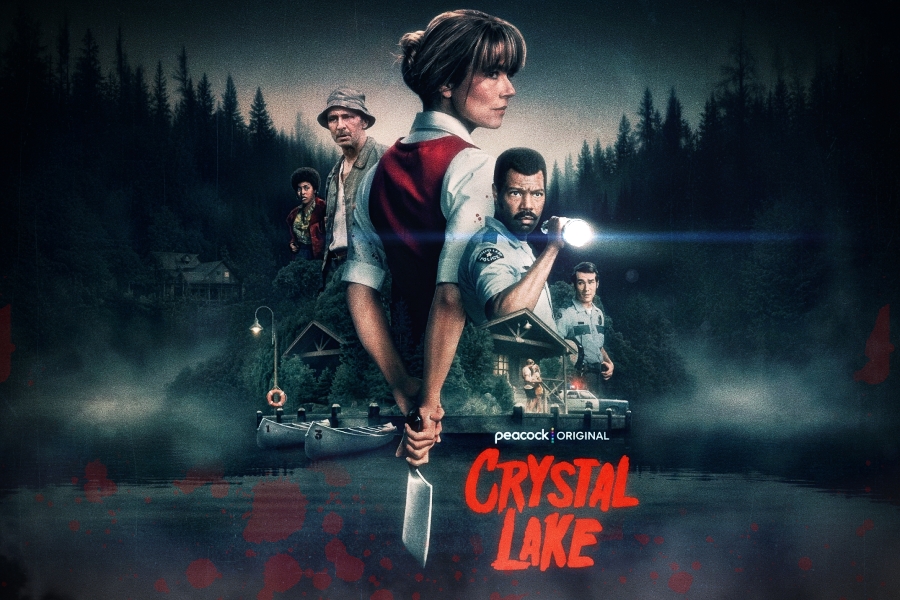
Set in the early 1970s, Crystal Lake follows single mother Pamela Voorhees as she struggles with intense grief and isolation after her young, disabled son drowns at Camp Crystal Lake. When a series of brutal murders plagues the community, Pamela and the townsfolk spiral into a web of escalating violence and secrecy.
Crystal Lake exists as a small triumph in and of itself.
Aside from an ill-fated video game and a glorified beer commercial (2025’s Angry Orchard short, Sweet Revenge), we haven’t had any Friday the 13th media since the 2009 reboot. With the long-running legal battles between original director Sean S. Cunningham and writer Victor Miller finally behind them, where the IP would go next was anyone’s guess. Starting from scratch and rebuilding the lore around Pamela Voorhees feels like the most logical step.

The opening shot makes the show’s intentions clear. Pamela, covered in blood, stares into a bathroom mirror and pulls a tooth from her bloodied fist. This version of the story is going to be ugly, surreal, and violent. With A24 at the helm, it’s also going to dig deeper than the extreme camp of the later sequels. But if you strip away the camp and gratuitous sex and violence from this particular IP, what do you have left?
A story about grief, loss, and vengeance, it turns out.
The original 1980 film touched on those themes, but Pamela’s reveal as the killer doesn’t come until the 11th hour. Her motivation is packed into a brief monologue from Betsy Palmer, leaving the viewer to piece together the rest of her backstory. Crystal Lake has the luxury of eight hour-long episodes to flesh out that monologue, and it places bets on what Friday the 13th fans actually like and dislike.
That extra time lets us get to know Pamela, the circumstances surrounding her son’s drowning, and the people around her. Crystal Lake feels like an actual town. We see how law enforcement works, how fast gossip travels, and even a bit of the class warfare among the kids at school. And while there’s plenty of inevitable machete-fodder, I was shocked by how much I cared about characters not named Voorhees. I was even more shocked by the profound sense of empathy the series builds for the Voorhees family itself.
That’s the show’s most important change: I care about Pamela and Jason as people, not as horror icons.
Turning Friday the 13th from a slasher into a drama-flavored psychological thriller shifts the dynamics in a big way. We know Pamela isn’t mentally stable, and we know Jason will eventually become an inescapable killing machine, yet the journey never feels forced or ham-fisted. You’re protective of Pamela and Jason from the first ten minutes and not just because the other characters are redshirts begging to be gutted. Even Barry and Claudette, who were killed in the opening of the original film, get real character arcs. That could easily have turned into wink-wink fan service in the vein of the Star Wars prequels, but it doesn’t.

That’s not to say there’s no fan service. There’s plenty, but it’s tasteful, and a few touches are reserved exclusively for the diehards. My personal favorite is how a few of the murders that occur leave the victims looking similar to the unmasked Jason designs in the original films. Also, I must give a shout-out to the production team for the period-accurate clothes and music. Everything about this show feels cozy and lived-in, much like the earlier films. That coziness is a big part of why the franchise has endured.
That attention to detail is fun for the fans but also showcases showrunner Brad Caleb Kane’s affinity for the source material.
Linda Cardellini is outstanding. Playing someone who can go from unhinged to grief-stricken to downright horrifying isn’t easy. Doing it while still feeling warm, kind, and motherly is even harder. Pamela is a complex character, constantly struggling with her emotions while keeping a sinister streak at bay. Most of all, Cardellini isn’t afraid to go for it. Whether it’s a scene where a mother sings her child to sleep, stares at a dead-still lake in grief, or removes the face of a victim, you believe it.
Gwendolyn Sundstrom is another standout as Grace Snell. Even though Grace was written exclusively for the show, it’s easy to get invested in her character and arc. As one of Jason’s only friends, she’s caught in a whirlwind of emotions: her own grief, a troubled home life, middle school social drama, and the pressure of becoming a young adult. Sundstrom’s performance feels genuine and believable, even when the story veers into heavy-handed territory. She’s definitely a talent to keep an eye on.

Crystal Lake’s take on Crazy Ralph (played by Nick Cordileone) is another nice touch. Much like Pamela, Ralph glides between wholesome and terrifying with immaculate precision. It’s a fantastic reimagining of a character who only appeared briefly in the first two films.
Despite violent kills in nearly every episode, Crystal Lake never feels like a traditional slasher.
A season-long story simply can’t be as fast-paced and tightly edited as an 85-minute film. With the narrative stretched across a television format, the show’s bigger changes to the lore naturally come under a much larger microscope. Does caring about Pamela and Jason make them less scary? Does explaining lore that fans have debated for nearly 50 years make it less interesting? Is this story even worth telling in this format?
I think it is, and I don’t say that lightly. The franchise has three very different eras. Parts 1 through 5 are grounded in reality, and Parts 6 through 8 lean into rooting for Jason. Meanwhile, Parts 9 through Freddy vs. Jason embrace absurd camp. Crystal Lake flirts with all three, but it ultimately falls squarely into the first.
Which era you love most will likely shape how you feel about the show.
The clearest example of a swing, without giving too much away, is that they do some scaling back regarding how much Jason was bullied as a child. He deals with a few nasty classmates and his own insecurity, but even the events leading up to his drowning have more to do with his own choices than with bullying. Diehards may bristle at that, but I’m personally glad they softened it. The notion that the kid with a disability grows up to be a monster can be just as harmful as the characters who bully kids with disabilities. Sure, we’d expect those bullies to suffer eventually, but there’s no real need to portray the child being labeled a “monster” as literally becoming one.

That’s not to say every big swing lands or knocks it out of the park. There are a few liberties taken in the back half of the season that shift motivations in a dramatically different way. Even if you count those elements as a miss, the series addresses theories fans have questioned for years. It’s also worth noting that, although the show uses familiar locations and characters, Crystal Lake is not a prequel to the films. This is a full reimagining, a reboot with a cleaner timeline and a fresh perspective on the lore.
Is the show perfect? Not exactly.
I love how they’ve opened up the world, but turning Crystal Lake into an ensemble drama centered on an entire town sometimes comes at the cost of what fans tune in for: Pamela and Jason. This is especially Pamela’s core arc as a grieving, vengeful mother. Part of me wishes she would have endured a little more as a way to fan the flames of her burning hatred for fornicating teenagers and bullies. She encounters a few during the season, but her interactions with teenagers are minimal and usually dealt with by rolling her eyes and moving on. Still, if we wanted to focus on just those two characters, the original movies already do a decent enough job.
However, the slower pacing of an eight-hour series introduces a different issue. Notably, many non-Jason storylines are left unresolved and never fully explored. Chief of Police Levon Brooks (wonderfully played by William Catlett) alludes to his past as a potentially crooked cop. It’s a great beat for the character, but it ultimately adds nothing to his arc or the show’s larger story. Grace’s arc briefly touches on everything from self-harm to discovering sexuality, only for each thread to be left unresolved by the finale.
In fairness, corrupt-cop and coming-of-age arcs are done so often that it’s a breath of fresh air not to lean on the usual tropes.
Still, these storylines feel like missed opportunities when the show never explores what they contribute to the bigger picture. Is Levon’s corruption a setup for redemption? Could Grace’s exploration of her sexuality offer a new perspective on the franchise’s long-standing “have sex, and you die” rule? The original films were defined by such elements. So much so, they literally invented the tropes of horror movie rules. Both ideas could have added another layer to the story, but neither gets the attention it deserves.
It’s always risky to build a backstory for beloved characters or a franchise that’s had its bones picked dry. But certain new elements are all but required to justify the story’s existence. A bigger plot twist that occurs during the last few episodes of the season will no doubt be divisive for fans and casuals alike. And even though it’s enough to add a new layer of complexity to the story we already know, it’s just very, VERY different. But again, restarting this franchise means that you must make at least some big changes. Otherwise what more could be done?
This leads to the biggest question: Who is Crystal Lake for?
At the risk of sounding superficial, I think there’s enough here to satisfy long-time fans of the franchise. At the same time, it successfully draws in people who don’t normally watch horror. Diehards get plenty of lore to chew on, whether or not they’re completely happy with the timeline adjustments. Meanwhile, the character drama built around the town’s subplots gives everyone else a compelling reason to stay.

As it stands, it’s a worthy, highly creative addition to the Friday the 13th franchise. I like it, and there’s a lot to love. I genuinely care about the characters and the world the series builds. Sure, I could pick a few narrative choices apart, but I do that with the original films, too. The showrunners are emphasizing a new cohesion, one where more seasons can expand and extend the story for years. At the very least, it can hopefully lead to more films in this franchise. But unlike a few other reboots of classic horror icons, this new take on familiar territory doesn’t make me nervous. It makes me excited to see where they take the IP next.
For the first time in Friday the 13th history, we’re in familiar yet uncharted waters, and I can’t wait to take another swim in Crystal Lake.
Crystal Lake is currently streaming on Peacock.