

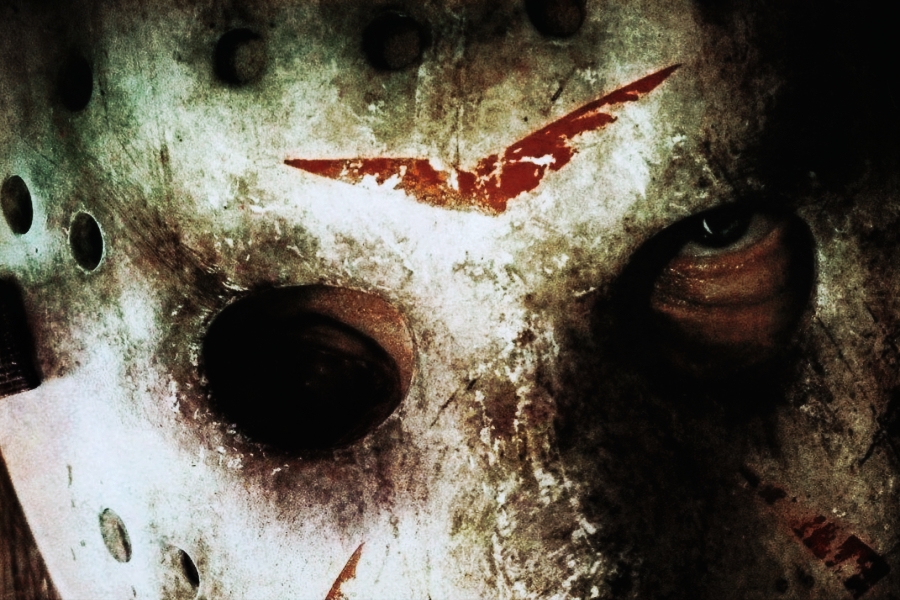

When a franchise spans four decades, having fan theories is a given, and Friday the 13th is no exception. You could try to stitch together the famously inconsistent continuity or make sense of Jason Voorhees’ increasingly ridiculous supernatural abilities. The series is a hotbed for YouTube deep dives and online essays.
It’s fun to theorize about a decades-old slasher franchise. However, some theories make you stop and wonder if the movies themselves might be stranger than we give them credit for. As I began my seasonal rewatch of the catalog, my own idea kept rising to the top of the Crystal Lake waters.
Is Jason Voorhees less of a character and more of a manifestation of trauma?
To be clear, I don’t mean Jason is imaginary. He leaves very real bodies behind, and plenty of characters see him do it. What I mean is that, film after film, he serves as a vessel for whatever pain the people around him carry. Some of the movies invite wilder, more literal readings, and those are worth entertaining as “what ifs,” even if the thematic interpretation holds up best.

We all know the films were made for quick entertainment and even quicker turnaround. Nobody is mistaking a movie about a masked killer hacking up teenagers for Citizen Kane. Yet, the more you look at the series, the harder it becomes to ignore how often Jason is connected to trauma. Be it grief, guilt, fear, or revenge, psychological projection plays a vital part in these characters. In fact, the more you examine the pieces, the more Friday the 13th starts to resemble a campfire story where Jason and his lore change depending on who’s telling it.
The first Friday the 13th introduces us to Jason’s drowning.
Pamela Voorhees spends years blaming the counselors at Camp Crystal Lake for her son’s death, and it eventually leads her on a path of murderous vengeance. On the surface, the revenge story is straightforward. We have a grieving mother who eventually becomes unhinged and believes anyone involved with the camp deserves to die.
However, there is one weird problem with the logistics. In the third act, Pamela is revealed to be the killer, but much of what happened leading up to that point would be difficult to accomplish alone. Environments are manipulated, traps are set, and the killer moves through the camp undetected while knowing exactly where everyone is. It begs the fan-favorite question:
Was Jason accompanying his mother during Friday the 13th all along?
Part II explores this theory by hinting that Jason never actually died in his childhood drowning. Midway through the film, Ginny Field theorizes that Jason survived and spent his life living in the woods around Crystal Lake. He was isolated from society and watched his mother from a distance. The movie never gives us a definitive childhood history for Jason, but his existence makes Ginny’s theory possible.
So what if Pamela genuinely believed Jason was dead while Jason himself was alive in the woods? That would explain the feral adult we see in Part II. It would also create an especially strange twist on the original movie because Pamela’s entire motivation depends on believing her son was taken from her.

But the trauma angle makes this theory even richer. Maybe the “Jason” Pamela talks to throughout the first film is a voice she’s conjured in her grief, a version of her son existing only in her mind. It’s a far-fetched idea, and a fun one, because it points toward something that pops up later in the franchise: Jason doesn’t need to physically appear to exist.
Just as his mother could have created a version of him in her grief, Jason can function as an idea, a justification for violence, and a vessel for pain.
That psychological element becomes much harder to ignore in the second film. Ginny isn’t simply another final girl who happens to survive Jason. She’s studying psychology, and much of the movie revolves around her attempt to understand the character her boyfriend Paul projects in a scary campfire story. She develops a theory about Jason’s childhood, his relationship with his mother, and the psychological damage caused by his supposed drowning.
Later, the movie appears to prove her right when she discovers his shack in the woods. Inside is Pamela’s severed head, her sweater, an altar, and the bodies of Jason’s victims. Alice Hardy, the survivor of the first film, appears to be among them. Ginny puts on Pamela’s sweater and manages to trick Jason into believing she is his mother before delivering what appears to be the killing blow.
But then, she wakes up.
That ending creates an unusual amount of ambiguity for a slasher sequel. How far back does Ginny’s “dream” actually go? Did she actually find the shack? Did she really put on Pamela’s sweater and psychologically manipulate him? The movie eventually moves on, but it never gives us the kind of clean resolution that makes every event feel completely objective.
The opening sequence involving Alice is similarly strange. Jason apparently tracks her down at home, sneaks inside, places Pamela’s severed head in her refrigerator, stalks her through the house, and kills her before seemingly returning to his life as a hermit in the woods. How did he find her? Why does he have access to her home? Why does he go through the elaborate process of terrifying her with Pamela’s head?

Friday the 13th Part II doesn’t bother explaining any of it. It simply happens.
That makes the Alice sequence feel almost dreamlike when viewed as a bookend to Ginny’s story. I’m not arguing that Alice’s murder is a hallucination or that the entire movie takes place inside Ginny’s head. Later sequels reference the events of the movie.
But Part II repeatedly blurs objective reality with psychological interpretation. Ginny spends the movie constructing a psychological explanation for Jason, and the climax turns that explanation into a physical reality. Whether the movie intentionally created that ambiguity or simply stumbled into it, it makes Part II one of the more psychologically rich movies in the franchise.
Part III introduces another survivor whose relationship with Jason is rooted in past trauma.
Chris Higgins returns to the Crystal Lake area after previously experiencing a terrifying encounter with a man there. Her memory of that event is worth pausing on because Jason’s behavior toward her has a sexual and predatory quality that feels unlike the Jason we see before or after the movie. Jason has never really been portrayed as a carnal killer. He’s usually an almost entirely asexual force of violence.
Yet Chris’s memory gives us a version of Jason who is much more intimate and threatening. That doesn’t mean she imagined the encounter, but it does invite the possibility that we’re seeing Jason through the lens of her trauma. If Jason is a manifestation of fear, he doesn’t necessarily have to behave the same way for every person.

Jason embodies grief.
Pamela’s Jason is an embodiment of grief. Ginny’s Jason is a psychologically damaged child. Chris’s Jason could be the embodiment of a very specific traumatic memory. The rest of the film is busy with teenage romance and frustration, which is easy to write off as the genre courting its target audience.
But one thread connects back to Chris. Rick spends much of the movie dismissing her fears and treating her memory as something to be managed, and that dismissal is part of what keeps her isolated. Chris may look and act like a typical teenage girl on the outside, but her crippling anxiety makes her an outcast even among her friends. Her Jason is purpose-driven and personal, the physical manifestation of the fear she can’t get anyone else to take seriously.
The outcast concept becomes even more compelling in Friday the 13th The Final Chapter.
Tommy Jarvis is an isolated, socially awkward kid who is fascinated by horror movies, monsters, masks, and video games. Meanwhile, his family is dealing with its own problems. Mrs. Jarvis is coping with her divorce, while eldest daughter Trish is trying to navigate adolescence and take on more responsibility within a fractured family. Despite being mature for her age, Trish secretly longs to be a normal teenager, much like the horny teenagers vacationing next door.

As a kid, Tommy is completely happy being a misfit who retreats into his own world. When Jason arrives, the two outsiders seem to share an odd connection. Jason was once an isolated and vulnerable child who became a monster. Tommy is an isolated child fascinated by monsters. The Final Chapter makes for a distinctive take on the slasher genre because the parallels between Jason and Tommy feel very much like past trauma and possible future trauma meeting head-on.
By the end of the movie, Tommy understands something about Jason.
He’s learned everything possible about the monster through newspaper clippings and stories. So, when Tommy finally confronts Jason, he doesn’t simply attack him. He transforms himself. He changes his appearance, grabs a weapon, and becomes frighteningly violent. For a brief moment, Tommy looks almost like a younger version of Jason.
Did Tommy literally become Jason? Of course not. But psychologically, the connection is revealing. Tommy had to recognize something of himself in Jason to face him. When he destroys Jason, he may be destroying more than the killer who attacked his family. He may also be destroying the version of himself his sister Trish fears he could become.
Friday the 13th Part V takes this idea to an almost accidental extreme by removing Jason entirely.
Story-wise, it’s the closest film to the original. We don’t see the killer until the final act, and when he’s unmasked, it isn’t Jason. It’s Roy Burns, an ambulance driver whose grief over his son’s death has curdled into revenge.
The killings take place in a halfway house where a now-teenage Tommy Jarvis is staying, and the film is more interested in the aftermath of trauma than any other entry in the series. Tommy barely speaks and spends most of the runtime anxiously withdrawn or on the verge of a panic attack.
His sleep is plagued by nightmares of Jason, and they bleed into his waking hours. The film uses this behavior to cast suspicion on Tommy, but the portrayal also reinforces the theme underneath the camp. Jason isn’t something Tommy escaped when he killed him. He’s something Tommy carries.

That’s what makes Roy’s story so compelling.
Tommy is the person trauma has hollowed out, and Roy is the person who turns it into a costume. When we see him don the hockey mask for the first time, it’s in a scene where he bursts through a door Jason-style. It’s hard to ignore that the final image of Part IV, Tommy’s chilling smile, hints at this possibility.
The ending of Part V takes it even further, with Tommy appearing in the mask himself, as though the identity is waiting for whoever is hurting enough to wear it. Even Roy’s exaggerated Jason-like abilities can be read through this lens. He’s not simply copying the killer’s appearance. He’s adopting the entire mythology. Someone suffers, seeks revenge, puts on the mask, and becomes the monster.
Jason has become a language of trauma.

Part VI further explores Tommy’s trauma, but in a much more literal sense. Now an adult, Tommy has spent years dealing with the psychological consequences of killing Jason as a child and facing a copycat killer. He returns to Crystal Lake because he wants to make certain Jason is dead.
Instead, he accidentally resurrects him. While silly in practice, the film represents what can happen when someone tries to confront trauma without actually being ready to face it. Unless you’re ready to face your inner demons with full confidence, opening the door to your trauma can inadvertently grant it more power over you than you imagined.
Now we get to Friday the 13th Part VII: The New Blood.
This might be the strangest movie in the franchise when viewed through the lens of trauma. As a child, Tina Shepard has telekinetic abilities. A decade ago, she accidentally kills her father during an argument on the docks of Crystal Lake. Her powers cause the dock to break apart, sending him into the lake where he drowns. As a teenager, Tina returns with her mother and a doctor who wants to study her abilities. During an attempt to use her powers to bring her father back, Tina accidentally awakens Jason.
At least, that’s what we think happens.

Tina’s entire story revolves around guilt. She has spent years carrying the trauma of killing her father. Accidentally bringing Jason up out of the lake could be seen as a physical manifestation of Tina’s own guilt, trauma, and fear. The movie has already established that Tina’s mind can affect the physical world. Her powers caused her father’s death, and at the end of the movie, they apparently bring him back.
Yet the idea that her father is somehow still sitting at the bottom of Crystal Lake after all those years creates its own logistical problem. Authorities presumably would have searched for his body. People have presumably continued visiting the lake. Yet Tina’s father is somehow still waiting beneath the water. If Tina can manifest her dead father, why couldn’t she manifest Jason?
The opening narration of Friday the 13th VII makes that possibility even stranger.
Instead of feeling like a conventional “Previously on Friday the 13th” recap, Jason’s history is presented almost like folklore. He’s a campfire story, a legend that has grown larger than the person who supposedly created it. Growing up in Crystal Lake, Tina has most likely heard the legends in passing. When her psychic abilities begin interacting with the lake, her subconscious could give her trauma a familiar face.

There’s also a curious detail that makes the theory more intriguing: outside of the opening narration, not one single character makes a reference to Jason until the beginning of the third act. The audience knows because we’ve watched seven movies.
But what do the characters actually know?
Is Tina consciously thinking, “I’ve awakened Jason Voorhees,” or is she simply encountering a strange, seemingly undead monster at the same lake where she killed her father? The distinction matters. We bring Jason’s mythology into the movie with us, but the characters don’t necessarily have to.
The ending then becomes a strange psychological mirror. Tina’s father goes into the lake at the beginning of her story. Jason comes out of the lake when she attempts to bring her father back. At the end, Tina’s father returns and drags Jason back into the water. If both figures are manifestations of Tina’s trauma, the entire movie becomes a confrontation with the two things she has spent years trying to escape: the person she accidentally killed and the monster she believes that act made her.
Read that way, the film is less a resurrection than a reckoning. It becomes Tina’s story whether or not you think of it as a continuation of what came before.

Jason Takes Manhattan deals with trauma in a different way.
By this point, he barely needs Crystal Lake at all. He’s practically an urban legend who can follow people anywhere, and the film seems to know it. The one thing tying him to the lake is Rennie, and her connection is personal.
As a child, she was thrown into Crystal Lake by her uncle, who thought it was the way to teach her to swim. She nearly drowned, and she’s been afraid of water ever since. That detail matters because it gives Rennie the same wound that created Jason. Both were children who went into the lake and didn’t come out the same.
It also reframes her visions.
She sees a boy in the water, and the premonitions feel less like a supernatural gift and more like her trauma finding a face. Jason doesn’t have to be a ghost haunting her. He could be the shape her fear took.
So when Rennie finally defeats him, the payoff is more than a gross-out effect. The hockey mask and monstrous body are stripped away, and what’s left is the child from her visions, the wounded boy beneath the legend. Despite being one of the weaker films in the series, that image is the clearest punctuation on what the earlier films hinted at.

Before Jason was Jason, he was a boy who drowned in Crystal Lake. Everything else came afterward: the mask, the machete, the supernatural resurrection, the mythology, the sequels, the merchandise, and the cultural iconography. Underneath all of it is still the child. And Rennie, by facing him, faces the child she once was and finally gets out of the water.
Jason Goes to Hell takes the Friday the 13th mythology somewhere completely different.
Jason’s body is destroyed in the opening minutes, but his evil carries on without it, jumping from host to host and tied to his bloodline. It’s the logical extension of what was hinted at in Part V. The monster is no longer a man in a mask but something that can be passed along.
The film also pushes Jason well beyond local folklore. He’s now a national story, covered by tabloid television and picked over by people who never set foot near Crystal Lake. The monster has become something larger than the place where he began.

That’s fitting because the franchise has gradually done the same thing with Jason’s trauma. It starts as one mother’s grief, then becomes a survivor’s fear, a child’s guilt, and a family’s pain. Eventually, it becomes something that can be inherited, imitated, and passed from one person to another. Just as Jason sheds his body and travels from host to host, trauma can outlive the person who originally experienced it. That may be the logical endpoint of the theory.
Jason is no longer simply a man who refuses to die. He’s an idea that can be transferred.
The films that followed, Jason X, Freddy vs. Jason, and the 2009 remake, skip much of that nuance. Instead, they lean into the camp that made the franchise a cult favorite. That doesn’t make them less valuable. They’re doing exactly what most people expect from the series.

Maybe Jason isn’t simply a person who refuses to die, but the trauma that refuses to die. Pamela’s grief creates the first version of Jason. Ginny attempts to understand the damaged child behind the killer. Chris returns to a place associated with a traumatic memory. Tommy recognizes something in Jason and later resurrects him while trying to confront his own past.
Later, Roy adopts Jason’s identity as an expression of grief and revenge. Tina may physically manifest Jason through her guilt. Rennie finds the wounded child beneath the nightmare. And by Jason Goes to Hell, the horror has become something that can be handed from person to person.
None of this erases the real reasons the Friday the 13th series contradicts itself.
That’s simply what happens when different writers, different directors, and studios chase the next sequel. But as a lens, the theory gives that inconsistency a purpose. Throughout each film, Jason’s strength and abilities change, as does his relationship with Crystal Lake and his relationship with death. The rules governing him seem to shift with each movie, too. Trying to make every detail fit into one coherent timeline is nearly impossible.

But what if we’re not supposed to?
What if every movie is another version of the Jason story? Pamela has her Jason. Ginny has her Jason. Chris has her Jason. Tommy has his Jason. Roy becomes his own Jason. Tina may create her Jason. Rennie experiences her Jason. The audience has our Jason.
That’s how folklore works. The story changes depending on who’s telling it. The monster changes depending on what the storyteller fears. He’s whatever the story needs him to be. He’s whatever the audience needs him to be as well.
And perhaps that’s why the Friday the 13th franchise has never been able to kill Jason.
You can destroy a body, burn a corpse, and drown a monster. You can send it to Manhattan or space. And you can even send him to Hell. But you can’t kill grief, fear, or a story. Most importantly, you can’t kill trauma simply by pretending it never happened.
Jason keeps coming back because somebody, somewhere, still needs him to. Maybe Crystal Lake doesn’t actually have a monster living beneath it. Maybe it’s simply the place where everyone keeps putting their monsters. And maybe Jason Voorhees is the face we’ve given them.