

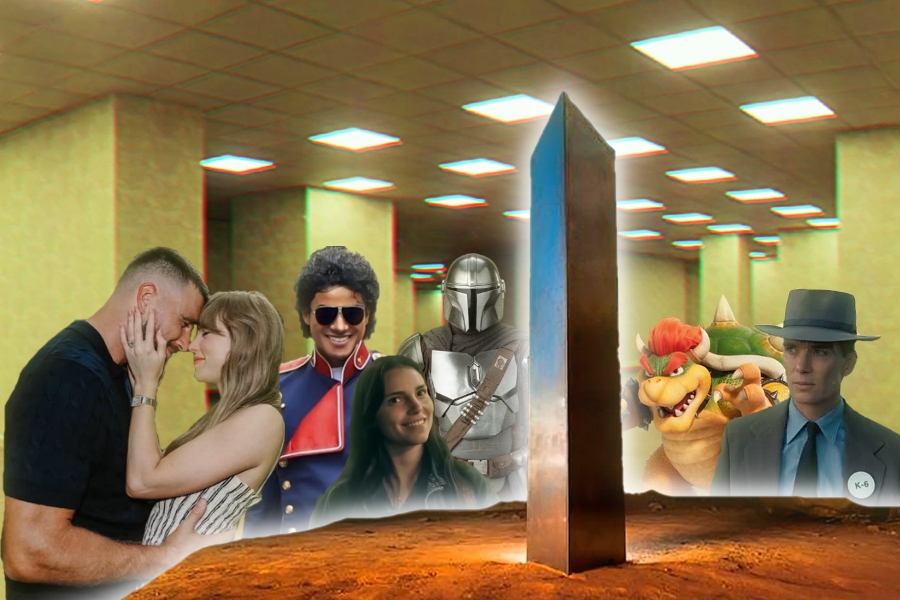

Think back to the launch of YouTube, Lady Gaga’s meat dress, or the absolute grip the Harlem Shake had on the internet. Don’t worry: I’m not getting nostalgic for the Aughts. I’m talking about a time when a pop culture event still had a truly monolithic impact. We used to have universal touchstones that dominated the water cooler conversation. Have you noticed how those have completely vanished? And no, COVID or politics don’t count.
We no longer gather around the same television show or buy the same album on release day. I think the last time I waited in line to buy a high-profile video game was Grand Theft Auto V. No singular cultural event can stop conversation anymore. It could be the internet’s fault that we’ve spent the last decade building fifty different rooms and then being surprised nobody’s in the same one. But I really don’t want to blame the internet for everything. I think that cultural events are more difficult to fake.
The bigger truth is, pop culture has been faking monolithic events for a while now.
Each streaming service wants the next Stranger Things, and every studio wants the next Marvel Cinematic Universe. Every label wants a racially ambiguous pop star capable of transcending genre, demographics, and basic logic. To our detriment, it has only produced a landscape shaped almost entirely by scale. Bigger budgets, bigger campaigns, and bigger expectations all combine in the service of increasingly cautious ideas dressed up as ambition. Why should they color outside the lines when they can manufacture dominance and spend whatever it takes to reverse-engineer the feeling of inevitability? That’s not new, though. However, what is new is how audiences are doing it, too.

At some point, ordinary people adopted the language of the industries they consume.
Grown adults spending precious time arguing about opening weekend grosses, Spotify streaming figures, and chart placements as though their mortgage depends on the outcome. Fan communities have transformed into marketing departments, defending the quarterly earnings of their favorite stars with the passion of people who actually own shares.
I don’t want to get into toxic fandoms again. But when you get emotionally invested in something’s success rather than the thing itself, any criticism of that success feels like a personal attack. Your taste, your identity, and your team all lose. So, when somebody says, “I didn’t love it” (which is a completely normal human response to art), it gets received like an act of aggression. That thin skin usually has very little to do with the movie or the album. But it has everything to do with the fact that people stake their entire personality on their favorite bit of pop culture performing well. That’s not exactly a great trade, nor is it an organic monolithic event.
The obsession with creating false monolithic dominance doesn’t just make people defensive. It makes art worse.
Every release now arrives pre-digested in metrics. Albums come with streaming projections. Films roll out with box office tracking. Before you’ve heard a note or watched a frame, the conversation has already shifted to whether something is winning or under-performing. That fiscal scoreboard is already running in the background, whether you want it or not, and the experience of just sitting with something gets crowded out by the noise. How do I know that Masters of the Universe is tracking for a $30 million opening, 3 weeks before its release? More importantly: Why should I care? If a movie makes a billion dollars on its opening weekend, does that mean it’s arguably better?

The scoreboard also lies. A disappointing box office weekend is not evidence that audiences have rejected a genre, much less a film. Did you know The Shawshank Redemption only took in $16 million during its initial theatrical run, despite now being on many all-time lists? A streaming hit is not proof that a particular style has won. Happy Gilmore 2 pulled in nearly 50 million viewers and still managed to be one of the worst films of all time. Every outcome gets read as a referendum on culture itself, as though millions of individual, inconsistent, deeply personal preferences can be summarized in a single number. They can’t.
Pop culture has never worked that way, with or without monolithic events.
As of writing this, Drake recently dropped three albums simultaneously and charted 42 songs on the Hot 100 in a single week. Cool. Historic, even. But we spent two weeks talking about the chart positions instead of whether any of it was actually worth listening to. Taylor Swift is worth two billion dollars. Billionaires shouldn’t exist, but good for her. But the conversation around her has calcified into a scoreboard so hardcore that pointing out a song is merely okay, and you’ll get tarred and feathered. Or at least treated like you kicked someone’s dog.

Film-wise, we have Obsession, which is a decent enough horror movie, getting talked about like it rewrote the horror genre. The “wish gone wrong” premise has been a horror staple for decades. But a certain corner of the internet populated largely by people whose cinematic history starts somewhere between Shrek 2 and Twilight decided this one was a revolution. If you don’t agree, you weren’t engaging with the film. You were attacking their whole personality. Meanwhile, the violence in Faces Of Death wasn’t visceral enough, and if you weren’t enlightened by Backrooms, you’re allegedly too stupid to live.
That’s not criticism, though, is it? That’s a loyalty pledge.
If a film is truly monolithic, it would pull in people from all walks of life and feel like a cultural phenomenon. And don’t get me wrong, Obsession and Backrooms are deserving of their success. But that doesn’t mean they are above any criticism. In the same breath, Masters of the Universe and The Mandalorian & Grogu don’t deserve to be blacklisted because they didn’t crack $100 million on their opening weekends. Jack Black saying “chicken jockey” in the Minecraft movie, causing every broccoli-haired teenager to lose their minds and trash the theater, is probably about as close as we’re gonna get, isn’t it? What a depressing thought.
The Beatles and The Velvet Underground were both making music in the mid-60s. One dominated every chart in existence. The other sold almost nothing. Here we are in 2026, and both matter enormously, for completely different reasons, to completely different people. And none of it has anything to do with the number of albums sold. The numbers captured a moment, but the music itself has outlasted it.
A work can underperform and still reshape everything that comes after it.
Another can dominate its era and leave nothing behind once the moment passes. Popularity and significance overlap often enough to confuse, but they are not the same thing. Treating them as interchangeable is how you end up defending a corporation’s quarterly earnings like it’s your kid’s Little League team. That doesn’t make me feel like I’m part of a cultural moment; it’s exhausting.

Since when did people not in the entertainment business become experts in the business and accounting field anyway? Imagine paying $15 for a ticket to see Mortal Kombat II, along with $12 for a Coke and $18 for popcorn. You sit down in the theater and pull out your calculator, trying to decipher how much of the ticket purchase goes into the pocket of New Line Cinema. I work in construction, but you’ll never see me tell a hairdresser how much clarifying shampoo they need to sell to make a haircut profitable!
Pop culture’s attempts to manufacture a monolith have made simply trying to enjoy something feel like a chore.
Taylor Swift fans buying 29 variants of the same album to inflate chart numbers isn’t fandom anymore. It’s unpaid data entry in service of a marketing strategy. As another example, the pre-release noise around Antoine Fuqua’s Michael was so loud and loaded with people demanding it was a cynical whitewash, but by the time I actually watched it, I wondered if I saw the same movie everyone else had. It was great! The entire theater acted like it was a concert! A bona fide blast.
Some artists are cancelling tour dates when arenas don’t sell out fast enough, as though a half-empty room is a personal humiliation rather than just a Tuesday. Of course, the price of a ticket is the biggest factor, and that’s a topic for another article altogether. But if these same artists picked a smaller venue from the get-go, they’d probably sell it out with no problem.
The whole apparatus has become so heavy that engaging with culture at all starts to feel like homework.
Admittedly, there’s a small part of me that’s relieved we don’t have a true monoculture anymore. If this is what the pursuit of a monolithic event looks like, I’m not sure any of us could survive actually having it. The desire for shared cultural touchstones isn’t wrong on its own. Shared experiences matter. They create something that algorithmic feeds can’t replicate.
This could be about how cellphones grant instant access to those numbers, too. But if you want to split hairs, the same could be said about any kind of information. Before smartphones, we had to rely on calling people to talk to and interact with them. In the same breath, we had to rely on the radio and MTV to hear new songs and see music videos. We needed to go to movie theaters to see film trailers. You get the idea.
Despite every form of entertainment being so readily available, nothing feels like any kind of event anymore, much less monumental. I would love to be excited for a new Star Wars movie or wait until midnight to get a new game or album. But at some point, the pursuit of that feeling curdled into something else entirely, and now a significant chunk of the audience has become the industry’s most effective and least compensated workforce. They do the marketing, police the discourse, and shame anyone who doesn’t participate in the collective enthusiasm. And they do all of it voluntarily, with genuine passion, in service of corporations that would restructure them out of existence without a second thought.

You can’t outsource your taste to a scoreboard and then wonder why everything feels hollow.
Here’s the part nobody wants to say out loud: When you spend more energy defending a release’s opening weekend box office draw than actually engaging with what’s in it, you are actively contributing to the death of the thing you claim to love. The constant complaint that music and movies aren’t what they used to be and that nothing feels meaningful anymore is downstream of this exact behavior.
We’re all trying to make something a thing when not everyone is connected to the same algorithm. In fact, it would be easy to blame algorithmic dripfeeds as the root of the problem, but that would let us all off the hook. No, society willingly doing the data analysis for the industry is just as big a problem. Especially when the industry chases dominance because the audience rewards dominance. The numbers become the story because the audience makes them the story. The art gets flattened into a product launch because the audience shows up for the product launch. But what about showing up for the actual art?