

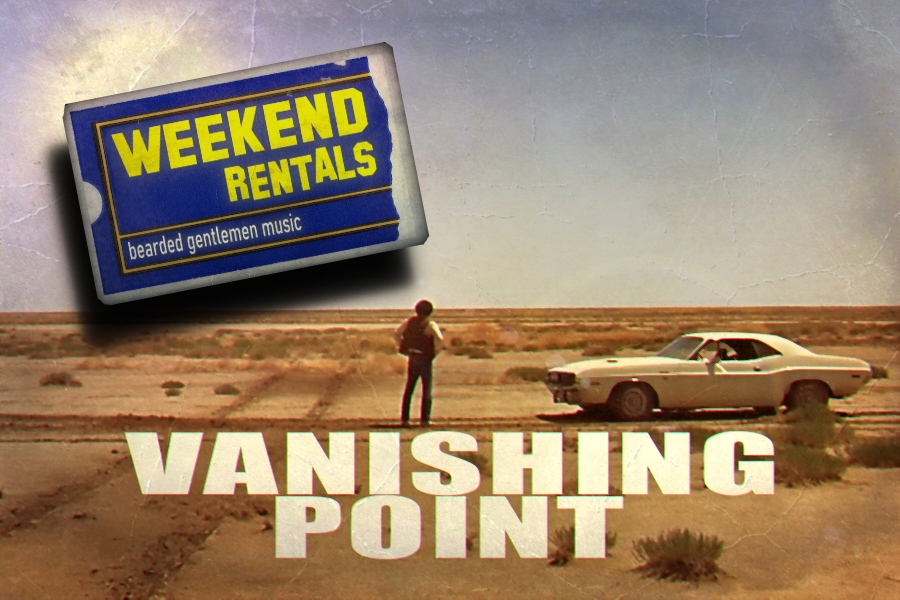

There was a time when Friday night didn’t mean scrolling endlessly through algorithm-approved thumbnails. It meant standing under the buzzing fluorescent lights of a video store, judging half-ripped VHS covers like ancient relics. You might’ve intended to pick up The Godfather, but you walked out with something from Cannon Films or Full Moon Features. That’s what the universe (or at least the “New Releases” wall) handed you.
WEEKEND RENTALS isn’t about the movies themselves. It’s about the ritual of being a regular patron of a vintage video store. It’s about the gamble that you might stumble onto something terrible and unforgettable all in the same night.
Tonight’s feature? VANISHING POINT.
Kowalski (Barry Newman) is a ghost in the machinery of the American Dream. He’s a shell-shocked Vietnam vet, washed-up motocross racer, and disgraced cop now drifting as a high-stakes car porter. His existence has been reduced to a single mission: Deliver a supercharged, “Alpine White” 1970 Dodge Challenger from Denver to San Francisco in 15 impossible hours.
High on amphetamines and a nihilistic need for speed, Kowalski’s sprint ignites a multi-state firestorm. As he outruns a mounting army of sirens and onlookers, he is guided by Super Soul (Cleavon Little), a blind DJ who broadcasts Kowalski’s flight as the gospel of “the last American hero.” Through the haze of the American desert and the echoes of a shattered past, Kowalski isn’t just fleeing the law. He is chasing a final, literal vanishing point on the horizon.
To understand why Vanishing Point resonated with audiences, one must first survey the wreckage of the American psyche at the dawn of 1971.
The 1960s had collapsed, taking the nation’s innocence down with it. The era of free love and sunshine had curdled into an age of anti-war vitriol and systemic dissent. Between the “Nixon Shock” and a landscape of civil unrest, even the most steadfast patriots found themselves adrift. Society was disoriented, disillusioned, and mentally exhausted. This friction between liberation and authority saturated the zeitgeist, bleeding into every lyric and lens. Across the cultural spectrum, a weary public no longer sought a revolution. No, they were ready for the counter to the counter-culture.

On a purely superficial level, Vanishing Point delivers as a high-octane, fuel-injected, rock-and-roll adventure. For the casual viewer, it is in the pantheon of ultimate car movies. It’s a loud, cool, and often profound cult classic centered on a fearless driver who will stop at nothing to win a bet. Between the legendary engine notes and the sun-drenched cinematography that showcases the American West, it satisfies every itch for ’70s action cinema.
Yet, it’s precisely this cool exterior that makes the film’s deeper layers so jarring. Beneath the chrome and burnt rubber lies a cinematic autopsy of the 1960s. Kowalski’s reckless lust for speed is less about speed than a desperate attempt to outrun the future, one that no longer has a place for his idealistic brand of individualism.
On a subconscious level, Vanishing Point exposes the jagged edges of an American tapestry riddled with systemic rot.
Throughout the film, we get brief glimpses of Kowalski’s past. Most notably, we watch him lose his badge after he stops a fellow officer from committing sexual assault. Just like in real life, the system protects the predator instead of the victim and punishes the integrity of a whistleblower.
The movie also establishes a foundation of institutionalized police brutality. This rot extends to the heartland through the lenses of racism and xenophobia. Super Soul, providing the soundtrack and live commentary to Kowalski’s flight, is eventually tracked down and brutally assaulted by local “good ol’ boys.” The cops trash his radio station in an act of violent bigotry that proves the “Summer of Love” never reached the rural interior.

The film’s handling of sexism is also a study in contradictions.
Women are cast as icons of liberation, yet they remain tethered to archetypes, sidelined by a culture whose grasp on gender equality was performative at best. It raises a haunting question of the era. If dissent is crushed, Black voices are muffled, and women are reduced to scenery, what is left for the straight white man?
With every action sequence and chance encounter, Kowalski begins questioning his own moral code. What did he fight for? Who was he trying to outrun? The clearer the picture gets, the less interested he becomes in such a future. In his fractured mental state, Kowalski’s own ideas about freedom become a hollow, tired myth.
The hypocrisy of the American Dream is most pointedly captured when Kowalski must make a pit stop in a desert revivalist commune.
Here, faith and industry have been reduced to a bizarre, transactional circus. A church congregation huddles in the wasteland, listening to a preacher who seems to be performing for ghosts. Meanwhile, an elderly prospector – once the ultimate symbol of the American pioneer – is now catching rattlesnakes to sell to the church for their theatrical displays.
The film blatantly portrays the death of the pioneer spirit that was so important to America in its infancy. The “gold” of the West has been replaced by the sale of dangerous spectacles to a bored, broken populace. The American Dream has devolved into a sideshow where even spirituality is a mere commodity. Huh. That sounds familiar.

This sense of universal desperation is further explored when Kowalski encounters two gay hitchhikers who attempt to rob him. In a moment remarkably ahead of its time, Kowalski acknowledges their sexuality without a trace of judgment. The film also refuses to sentimentalize them as saintly victims. They are desperate, flawed, and criminal, displaying a raw humanity that suggests they suffer from the same moral decay as everyone else on the road.
When Kowalski throws them out of his car, it’s a strange act of equality in itself. He treats them exactly as he would any predator regardless of sexual preference. Yet, in a nation built on greed and colonialism, does only the desperation to survive truly bridge the gap?
The women in Kowalski’s life serve as the final milestones of his spiritual erosion.
A flashback reveals that his girlfriend drowned in a surfing accident and how it had a profound effect on his life. This represents the end of pure, uncomplicated hope that may have kept the character grounded. Later, he briefly encounters a nude woman riding a motorcycle in the desert, indicating the tragic inevitability of his own radical freedom. She is free and innocent, but because she is alone in an empty wasteland, the film questions whether her freedom means anything at all.
Finally, as the end nears, Kowalski picks up a mysterious female hitchhiker. Their vague, stoned conversation feels less like a chance meeting and more like a visitation from the Angel of Death. Instead of a hedonistic encounter, her arrival feels more akin to settling a survival debt. The meeting prepares him for the final destination foreshadowed at the beginning of the film.

The sonic canvas of the film, as portrayed by Super Soul, serves as a frantic, auditory collage of the nation’s fractured spirit.
While diverse, the soundtrack acts as a direct reflection of the American “melting pot” and how it only colors the truth. The lyrics of each song seemingly matching character motivations, creating a soundtrack that’s a deliberate cross-section of American identity. Soul, R&B, gospel, hard rock, country, and folk each represent a different cultural pocket colliding on the open road. Each plays parallel to what Kowalski may or may not be feeling.
The two inadvertently bridge a racial divide that the physical world the film violently enforces. However, this harmony is fleeting. When Super Soul broadcasts “Where Do We Go From Here” over Kowalski’s high-speed chases, music becomes a literal “Black voice” powering a “white car.” The distorted grit of Mountain’s “Mississippi Queen” captures the aggressive liberation of the counter-culture.
Meanwhile, Jerry Reed’s “Welcome To Nevada” evokes the rugged, traditionalist myths of the American West. The same could be said for the various gospel tracks. “Sing Out For Jesus” by blues legend Big Mama Thornton and “You Got To Believe” by Delaney & Bonnie (who make a brief appearance in the film) represent the spiritual innocence one wishes to believe. This sonic blend promises a unified American spirit but underscores a deep disillusionment. Unfortunately, the melting pot has boiled over, drowning diverse voices in the roar of an engine hurtling toward a dead end.
As Kowalski blurs the line between pavement and the horizon, his isolation becomes a sanctuary of pure velocity.
This isn’t about being right or wrong. It’s the absolute freedom of being the only soul in the world who hasn’t been corrupted. Ultimately, the film reveals its core truth. The American Dream is a superficial construct built upon the systematic destruction of the “other.” The vast beauty of the West is merely a facade for a nation founded on hatred, racism, and greed. And let’s never forget the wreckage of consumerist failure. Consequently, the movie proves that the only way to remain a “free soul” is to either stop running or never stop running.

Decades later, Vanishing Point remains hauntingly relevant.
Artists in each subsequent generation have grappled with their own cycles of disillusionment, existential dread, and civil unrest. Its influence is still being felt today, including directors like Edgar Wright and Quentin Tarantino, while also being a favorite of Steven Spielberg. Guns N’ Roses sampled segments of Super Soul’s monologue in their song “Breakdown.” In 2003, Audioslave remade the film with their “Show Me How To Live” video. Similarly, Primal Scream’s 1997 album, Vanishing Point, was written as an alternative soundtrack for the film.
The overarching merit of the film is ultimately a matter of perspective. It functions equally well as a gritty artifact of 1970s counter-culture or a biting critique of the American identity. To view it as the latter is to confront a hauntingly modern anxiety. Has the American experiment finally exhausted its momentum, or has the foundation always been this precarious? It poses the chilling possibility that the country hasn’t actually changed; it simply ran out of road. Maybe we’ve always been too young, naive, and submissive to see the bulldozers parked in front of us all along.

Vanishing Point is currently available to stream on the Internet Archive.