

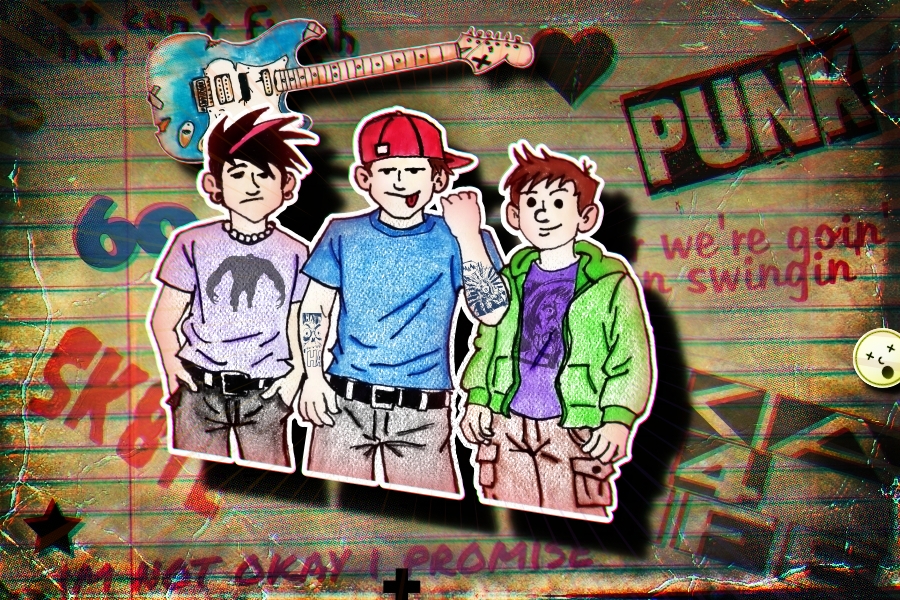

I’m just gonna say it: I hate pop-punk. Like, with a seething passion. Not just hatred, but passionate rage. When I hear anyone over 25 years of age singing about high school hierarchy with a snotty faux-teen voice, my soul tries to physically eject itself from the confines of my body. That formulaic approach to chord progressions, cadence, and the drums versus vocals in a tight race of who can over-play or over-pronounce the most per measure.
If my second-hand embarrassment had a soundtrack, it would include Blink-182, New Found Glory, and NOFX.
A single millisecond of a Sum41 song triggers my brain’s Federal Emergency Management siren. To say pop-punk is the bane of my existence would be a dreadful understatement. However, putting my snobbery aside, I feel like it’s time to have an open conversation about the genre and the blind defense provided by its fandom.
Pop-punk’s origin story usually starts with the eternal asterisk. Sure, the Ramones are often crowned the genre’s godfathers. Fair enough, three chords, bubblegum hooks, and a total disregard for excess will do that. However, musicologists will tell you that the Ramones were more about pre-Beatles rock n’ roll than anything resembling what would constitute as Punk.
But while the Ramones lit the fuse, it was the Descendents who drafted the blueprint everyone’s still tracing today. They took hardcore’s velocity and injected it with self-deprecating humor, suburban malaise, and actual melodies. Then came the mainstream success of the subgenres, and suddenly, punk wasn’t just about sneering at the world. It was about being a lovable loser in it. Every bratty chorus and heart-on-sleeve lyric that followed owes more than a little to that pivot.
Pop-punk became the ultimate sanctuary for the misunderstood (or melodramatic).
In a world that often feels heavy, there is a kinetic magic in those three-chord anthems of suburban escape. For many, this music was a lifeline. Are you bored with your hometown? There’s an anthem for that. Did your school crush forget you exist as they go out with someone totally not right for them? Pop-punk has you covered. How about a love letter to an endless summer with your crew as you cruise around on your decks? Yep, pop-punk has the soundtrack.
In the abstract, I believe that’s a good thing. Kids need something to relate to. It’s existentially important to find a record or a band whose music reflects their adolescence. For better or worse, pop-punk is a genre ready-made for the youth.

However, the genre ages, and its fans grow up. Music fans face a difficult crossroads between cherished nostalgia and modern accountability. Loving something shouldn’t mean wearing blinders. A full-grown adult unironically enjoying music meant for teenagers might be problematic by default anyway. To truly honor the music that may have raised you, we must stop ignoring the “bad seeds” and start holding the scene to a higher standard.
Pop-Punk’s reliance on a “Peter Pan” complex creates a unique stagnation.
When 40-year-olds mimic the teenage angst of their own youth, it can feel performative, and it also reinforces a bubble of White privilege. The foundational themes of pop-punk – specifically hating your “boring” hometown and suburban tedium – are rooted in a specific socioeconomic security. While these emotions are valid, they are often superficial compared to the systemic struggles faced by the Black communities that actually pioneered the rock sound. Creating an entire discography that laments being “suffocated” in a safe, middle-class neighborhood is, in itself, a flex of privilege the scene rarely acknowledges.

To extend that discussion of White privilege, pop-punk can often escape accountability for bad behavior in ways other genres or scenes do not. Hip-hop is the perfect example of this. Rappers often project themselves as tough, stoic, and masculine. And when a rapper partakes in questionable behavior, they’re often seen as dangerous, scary, and the root of societal decline. Meanwhile, most artists in the pop-punk world are depicted as harmless, sensitive, and even, at their most juvenile, the suburban boy next door. When someone is outed as problematic, it gets deemed an isolated incident. When other figures in the scene jump to that person’s defense, the treatment is as if it’s a few bad apples. If that’s not White privilege, I don’t know what is.
The stark contrast between punk as a movement and pop-punk as a genre becomes an argument between aesthetics and provocation.
That’s not to say pop-punk can’t say anything meaningful or existential. Plenty of bands do try to say something, and many artists are trying to grow. Kudos to them! Green Day has spent the last 20 years of their career dedicated to political lyricism. (Then again, they still use homophobic slurs and ableist language, willingly sampled disgraced pedophile Gary Glitter, and collaborate with known groomer Tim Armstrong of Op Ivy and Rancid. So, I guess that’s something.)
It’s just that the mission statement of pop-punk generally hovers around the superficial and juvenile. After all, who really wants to hear about civil injustices from grown white men who wear backwards caps, board shorts past their knees, and checkered shoes? That approach lends itself better to stories of parents not understanding teen angst or being dumped in a Taco Bell parking lot.
There is a profound irony in how what started as an alternative to the flamboyant egos of ’80s rock stars eventually adopted the same toxic traits.
While ’90s alternative culture mocked the excess of hair metal, pop-punk entered the ’00s simply swapping the spandex for skinny jeans and “weaponized relatability.” By marketing themselves as the “boy next door,” men in the genre created a false sense of equality that masked dangerous power imbalances. This accessibility made predatory behavior easier to hide and harder to challenge within the “Boys’ Club” hierarchy.

For all its mythology as a DIY carnival, the Vans Warped Tour incubated a darker reality. It was a touring ecosystem where access became currency, and oversight lagged miles behind the buses. Young fans sought proximity to bands and artists formerly insulated by status, and the industry was too eager to cultivate its stars. Stories piled up of pop-punk’s smiling poster boys abusing that imbalance, preying on underage and vulnerable fans, but the scene looked the other way. It’s a stain on the culture of pop-punk that complicates the nostalgia, a reminder that a community without accountability can curdle into complicity.
How did the people behind Van’s Warped Tour handle accountability in pop-punk? Well, they kinda didn’t.
Warped Tour founder, Kevin Lyman saw himself as a pseudo-guide for troubled artists on the roster. In addition to constantly booking bands with less-than-favorable pasts (such as Anti-Flag, Blood On The Dance Floor, Lostprophets, and Front Porch Step, to name a few), he often dismissed the negative stories from victims and survivors. Lyman even went as far as shrugging off rape and sexual assault allegations as nothing more than ‘witch hunts’ or the by-product of the scene, rather than a systematic issue.
I can’t stress it enough: Pop-punk is a genre whose primary market is young adults, teenagers, and children.
Think about it for a minute: when a genre, singing about things kids relate to, that’s who the audience is going to be. This is true no matter if you’re in your 20s, 30s, 40s, or beyond. Now, think about how all these songs are about worshiping the ground a girl walks on. It’s more than likely certain kids are going to want to be desired the same way one day (not to mention by the artists they admire).
This makes the environment prime for grooming or worse. Not to mention, it’s a genre where mostly White men are running the narrative. I really don’t think I need to explain how or why men are the worst, but if you read the lyrics to just about any angry pop-punk or emo song, you’ll probably have a good idea.
I want to remind you that I am using Warped Tour as a single example. Countless promoters and figures in pop-punk and other adjacent scenes turn a blind eye to problematic behavior, if not being directly involved in said debauchery. When we gloss over these themes in the name of nostalgia or “Aw shucks, it’s all in fun,” we allow toxic patterns to repeat. The scene has frequently prioritized protecting the reputation of the artists, specifically men in general, over the actual safety of its most vulnerable fans.
This power dynamic is mirrored in the lyrics.
Many of the genre’s hits rely on the trope of the “villainous ex-girlfriend” to justify male angst, painting women as either disposable or malicious. This narrative of the “nice guy” has often been used to shield the scene from its own misogyny. On the surface, a guy idolizing a girl can be endearing and romantic. But when the feelings aren’t reciprocated, idolization often becomes violence towards women. Bands like Say Anything, Brand New, Taking Back Sunday, and Fall Out Boy have countless songs about wishing harm on the girl who broke their hearts. Sometimes, it’s superficial and petty (“Cute Without The ‘E’” and “Nobody Puts Baby In The Corner”), but other times, it’s troubling and horrific (“Little Girls” and “Seventy Times Seven”).

These songs, bands, and scenes often create situations for an audience who may not be mature enough for a serious relationship. The last thing any teenager needs is to be groomed for emotional imbalance or possible vengeance, especially when it’s marketed as normal as acne and prom dates.
Can aging pop-punkers still sing about teenage relationships? More importantly, should they?
Break-ups and unrequited love are vital elements of the human condition. It’s completely understandable how young audiences can gravitate toward a genre that reflects the audience as much as the audience gets the artists. But manipulating the familiar to perpetuate a stereotype is problematic. And that’s just speaking of the artists who are young adults themselves. Things get even murkier when pop-punk bands have been around long enough to become legacy artists. It all loops back around to the Warped Tour environment in a disgusting oroborus of prey and predator.

Addressing these issues isn’t about gatekeeping or stripping away joy. It is about mindful consumption.
We can acknowledge that music brings happiness in dark times while simultaneously demanding transparency. All genres have “bad seeds.” Don’t get me started on the racism and supremacy within the metal community. But ignoring the sexism and predatory history of pop-punk only ensures those issues remain. True fandom involves holding the things we love to a higher standard so that the community can finally grow up alongside its listeners.
There are issues within every scene. But these problems existing in a genre so deeply rooted in adolescence just feel extra off-putting to me. Even when an older pop-punk act isn’t being predatory, it still feels obnoxious and embarrassing. It’s very much like Christian music in that sense. The religious elements make the rock n’ roll corny, and the rock n’ roll makes worship feel superficial, if blasphemous.
With that said, it’s okay to enjoy things! If pop-punk floats your proverbial boat, more power to you!
The world sucks right now, and every single person deserves to have some joy in their lives. And you know what? If that joy means listening to Simple Plan, Bowling For Soup, or Fall Out Boy, then who am I to judge? Believe me, I listen to all sorts of stuff that the general public would likely deem reprehensible.
There still has to be accountability. Part of that must come from within the scene itself, a genre for and about a young demographic. Music can and should be a safe place for everyone of every age, but you can’t make that a reality if you lack self-awareness.
I’ve come to this conclusion by being on the outside looking in. It has always felt either predatory, being marketed to kids, or cringeworthy coming from adults who refuse to grow up. Of course, there were outliers and bands I do enjoy. But most of them have grown up with the listener, and their creative output matches their maturity. Taking Back Sunday and My Chemical Romance come to mind as bands that separated themselves from the Emo side of the genre. Hayley Williams of Paramore has not only apologized for the problematic lyrics of their hit “Misery Business” but has also gone on to be a remarkable activist in and outside of the genre.
Artists can reflect and move past stunted growth. And it all doesn’t have to be dark and dire; there’s still plenty of fun to be had. It’s also good to see young bands like The Paradox going against genre norms.

I know what you’re thinking: I’m a jaded curmudgeon who hates anything fun.
Maybe you’d be right? At least partially, anyway. I hate nostalgia, so that removes a big chunk of real estate from the pop-punk lexicon. As mentioned earlier, Peter Pan Man Children make me want to die of cringe, and listening to music specifically made for children just feels gross to me.
I also despise gatekeepers with the same vehemence, so don’t waste your time coming at me. I grew up listening to hardcore and metal, so I have plenty of thoughts on those scenes, too. If I can come down on Glenn Danzig, no one is safe! Just give me enough time.
However, I also feel there comes a time when both bands and listeners should probably stop reveling in the past and, for lack of a better term, grow up. This same argument can easily be applied to just about every genre and its respective scene. We’re all adults here, right?
For more information on surviving problematic pop-punk scenes and what you can do to make them safer for everyone involved, please check out the Enough. Podcast.