

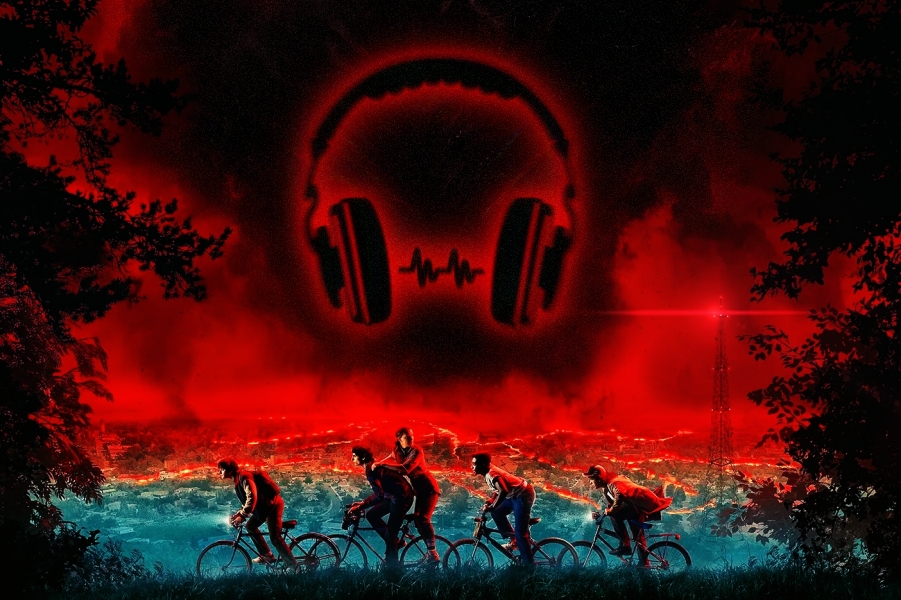

A certain kind of moral panic bubbles up every time a piece of pop culture accidentally does something right. When Stranger Things dropped a generation of kids into a Reagan-era fever dream full of bikes, telekinesis, monsters, and government goons, nobody really expected it to become such an effective music history course for Generation Z. And yet, here we are. A Netflix show about the human condition and cosmic goo somehow managed to do what their parents, teachers, record store clerks, and streaming algorithms couldn’t: Make Zoomers genuinely curious about music that was made before 15 minutes ago.
The sound department of Stranger Things didn’t push content or vibes. They used legitimately good music.
A show that takes place from 1984 through 1989 should naturally have an insane amount of needle drops. However, we didn’t get nostalgia tourism for Gen Xers alone. Outside of a few obvious choices (Toto’s “Africa,” Cyndi Lauper’s “Time After Time,” and Madonna’s “Material Girl” come to mind), Stranger Things featured an impressive amount of deep cuts from stellar artists. While parents were busy pointing at the screen and saying, “I remember that song,” kids were Shazaming it, falling down rabbit holes, and realizing (often for the first time) that music hasn’t always come pre-packaged as algorithmic brain rot designed to evaporate after 90 seconds.

The most obvious example – the one everyone has already litigated to death – is “Running Up That Hill” by Kate Bush. That track solidified Stranger Things as a hub for oldies off the beaten path. A song that once lived comfortably in the “beloved but niche” corner of ’80s art-pop suddenly became the emotional backbone of Max Mayfield’s trauma arc. For many younger viewers, it wasn’t an old song rediscovered: it was strange, urgent, and dramatically unlike anything dominating contemporary pop radio. No Auto-Tuned confessional mumbling or ironic detachment, the tune delivered raw feelings, big synthesizers, and a woman absolutely swinging for the fences.
And here’s the thing: the song didn’t hit because it was retro. It hit because it’s a good song. The show trusted its audience enough to let the music do the work without remixing or a retro-baiting cover by a current artist. Instead, viewers got the original track, unapologetically intact. That uptick in popularity of a three-decade-old track single-handedly reminded everyone that emotional sincerity never goes out of style.
From there, the door was open, and fans stepped through for a closer listen.
Suddenly, The Clash weren’t just a logo on a dad’s old T-shirt. Despite “Should I Stay or Should I Go” being the closest the band ever got to pop, its inclusion in Season 1 brought tension and urgency. Effectively threading paranoia and rebellion through Hawkins like exposed wiring, not unlike the persona of Jonathon Byers. Punk, in this context, was more of a worldview than a fashion statement. For younger viewers raised on rebellion-as-marketing, that mattered. Bands like The Clash, Joy Division, and New Order sounded alive, dangerous, and curious. They hinted at a world where music could argue with power instead of just soundtracking it.

That sense of discovery extended well beyond punk. David Bowie hovered over the series like a benevolent ghost embodying transformation, alienation, and the terror of becoming someone else. Peter Gabriel’s haunting cover of “Heroes” added so much weight to the scene where Will Byers’ lifeless body was discovered at the bottom of a quarry. Kids encountering Bowie through Stranger Things didn’t meet him as a larger-than-life legend: they met him in the shadows, where identity is fluid and nothing feels settled. Having Bowie’s original play during the credits of the final episode sounded cathartic and triumphant.
For all its gloss and nostalgia, Stranger Things wasn’t afraid to get grimy in its crate-digging, either.
The Cramps slithered into the mix, all sleaze and psychobilly menace. This wasn’t safe, sanitized retro rock. It was confrontational and weird, the kind of music that doesn’t ask permission. For younger listeners accustomed to frictionless consumption, The Cramps served up a shock to the system, teaching them that music didn’t always want to be liked. How Mike Wheeler, a teenager from a small Indiana town, discovered The Butthole Surfers in the ’80s is anyone’s guess. But having the character feel as passionate about “Human Cannonball” made him feel relatable to the outcasts who were probably beaten up for enjoying such weird music back then.
Speaking of outcasts, metal got its cultural moment in Stranger Things in the form of Iron Maiden, the now-immortalized “Master Of Puppets” from Metallica, and even Extreme’s “Play With Me.” Eddie Munson’s love for Maiden wasn’t framed as a punchline or a moral panic relic. It was earnest and empowering, placing metal in its original shorthand for outsider identity. Just like listeners in the 1980s, Eddie found strength in the genre that authority figures didn’t understand and actively feared. Younger viewers didn’t see “dad metal” – They saw catharsis, community, and imagination unleashed at full volume.

Balance made it all work. Stranger Things paired darkness and rebellion with ample warmth.
Inclusions like “Don’t Mess Around With Jim” by Jim Croce added texture, grounding the supernatural in something recognizably human. That brand of ’70s folk storytelling reminded younger listeners that songs could share strong narratives and characters inside three minutes of melody and lyric. The unguarded joy of “The Neverending Story” and Tiffany’s cover of “I Think We’re Alone Now” were pure, goofy, and deeply human. In a show filled with cosmic horror, those moments reminded viewers (especially younger ones) that sincerity isn’t weakness. It’s survival.
The same goes for the quieter, more unexpected choices. Fleetwood Mac’s inimitable “Landslide” offered reflection and emotional weight without spectacle, while the Cowboy Junkies’ cover of “Sweet Jane” connected the dots between vulnerability and swagger. These songs didn’t check nostalgia boxes. They felt right, because they understood that emotion doesn’t age.
Such tunes provided extra resonance during a scene where the older kids promise each other to stay close friends and meet up once a month. Of course, the adults watching know that promise will be broken as soon as crippling responsibilities come into play. They know how precious time is when you’re married, raising kids of your own, and working 40 hours a week on the other side of the country.
Then there’s Prince. Much like Bowie, Prince doesn’t need rescuing or rediscovery, but his presence in the show mattered because it contextualized him.
Using “When Doves Cry” and “Purple Rain” during pivotal scenes of the finale made Prince feel like a living part of the cultural ecosystem the characters inhabited. Prince wasn’t “important.” He was there. Funky, sexual, fearless, and gloriously unconcerned with genre boundaries. For kids encountering him in that context, Prince became less of a syllabus requirement and more of a permission slip.

That’s the real trick Stranger Things pulled off in terms of sound design. It didn’t lecture or turn music into homework or eye-rolling Easter eggs. It embedded these artists into moments of fear, joy, grief, and connection. They were emotional cues, identity markers, and in some cases, survival tools. Music mattered to the viewers because it mattered to the characters.
I’ll be the first person to tell you that the show isn’t perfect, especially in the writing after Season 2). But Stranger Things got plenty right.
It completely nailed introducing younger viewers to horror, science fiction, and, of course, music. Moving forward, I think many of Zoomers will be open to a world of entertainment that has often seemed outdated and cringe-worthy. This music belongs to them now! That in itself is priceless. A special shout-out to Kyle Dixon and Michael Stein of Survive is warranted, too. Their 80s-tinged score, ranging from malevolent to heartbreaking, was vital to the show’s success. Probably more than most viewers even realize.

In an era where discovery is increasingly passive (and getting oddly conservative), where algorithms spoon-feed listeners more of what they already like, Stranger Things reintroduced fiction and friction. It reminded younger audiences that the best music doesn’t always sound like anything you’ve heard before. Sometimes, it scares you a little or, at the very least, it should ask something of you.
And if a supernatural Netflix show has to be the thing that teaches kids that art can be risky, personal, and transformative, then so be it. Rock ’n’ roll has survived worse.
The complete series of Stranger Things is now available for streaming on Netflix.