

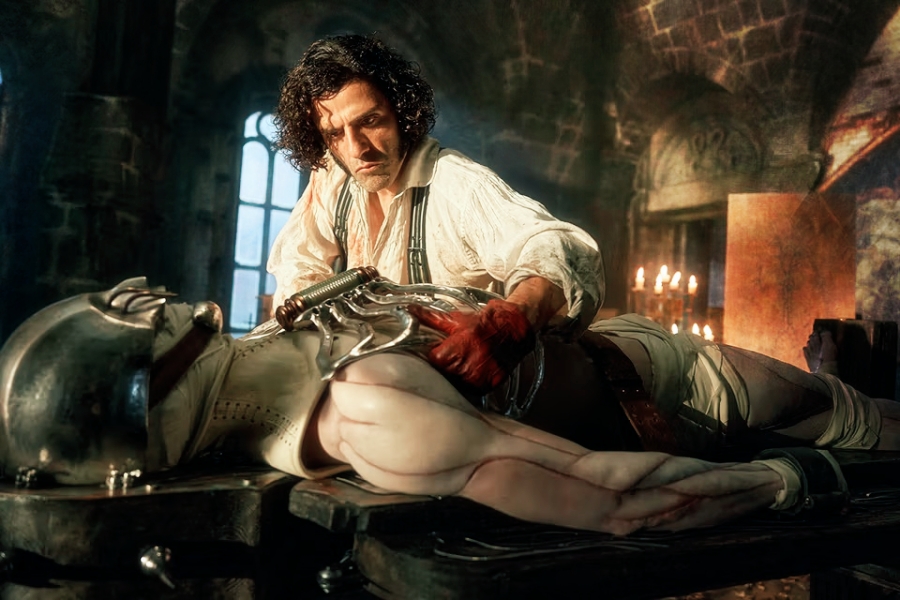

After the exceptional and visually disturbing Pinocchio (2022), Guillermo del Toro brings us another creation myth, Frankenstein. If you never thought of the parallels between those two stories, I’m sorry for putting them in your head. Both stem from that obnoxious human need to play God. I read Mary Shelley’s original novel many decades ago; thus, I come to this film mostly informed by popular culture and the Hotel Transylvania movies. Mind you, Frankenstein, or The Modern Prometheus, was published when Shelley was eighteen, so she wrote it before that. Save that nugget for your trivia nights.
Mild to severe spoilers ahead. Side effects may include changing your mind about the role of humanity in the universe; the realization of our inability to not be shits; a permanent sense of impending doom; and behavioral distress, as in wanting to be a better person. You’ve been warned.
THE UGLY
Del Toro’s visuals always stir something in you. Whether it’s awe, trepidation, or disgust– it’s irrelevant; you cannot escape their impact. We watch relevance for the human body in this film. A battlefield becomes no different than a slaughterhouse. Corpse puppetry is intentional and devastating. Emotions are weapons, mostly fucking the wrong victim.
DEATH IS TRANSACTIONAL IN FRANKENSTEIN, ALMOST A MEANS TO AN END. THE EGO WOLF DRESSES AS PROGRESS SHEEP.
The film starts by telling us that what we’re about to see is a “prelude.” We’ll find out later that the film is divided into specific segments, and I have thoughts about that choice. The camera pans over snow battered by wind. An inscrutable location card appears: FARTHERMOST NORTH, 1857. The bird’s-eye view continues until we find a ship stuck in ice and men working to liberate it. Night falls. An explosion and fire in the distance prompt an investigation. The party finds a wounded man. Something roars nearby. They rush with their newfound broken charge away from it.

A tall roaring beast follows the sailors. They defend themselves by shooting the thing at ground level. When that doesn’t work, most retreat onto the stranded ship, but some brave the beast one-on-one. Those idiots die– gruesomely. This is but a taste of what’s to come. Gaining the deck and surrounded by terrified but ready-to-attack sailors, the beast roars more.
“Bring him to me,” it demands, pointing at the rescued man. A sailor removes the beast from the deck by summoning the lovechild of a shotgun and a cannon. Harmed but not defeated, the beast pushes the hull, intent on overturning the ship. About to capsize, the shotgun-canon contraption breaks the ice to drown the beast in the waters below. Monster gone, the captain and the ship’s doctor return to the wounded man. Through convoluted dialogue, we get remorse and information. We also learn we’re in the presence of Victor Frankenstein (Oscar Isaac).
EVEN IF BEAUTIFULLY DECADENT, THE FIRST PART OF “VICTOR’S TALE” GAVE ME KRAVEN THE HUNTER (2024) PTSD.
Petty childhood grievances surge as fuel and vehicle for grandeur. Young Victor F. tries to color his parents’ marriage of convenience as a sad thing; the rose-tinted glasses created by modern storytelling about love before our time. Well, clearly not Victor, but Del Toro falling prey to that romanticized bullshit. Marriage has always been a contract, and the involvement of love was an exception, not a rule.
Nevertheless, we’re seeing this portion from the perspective of a child who loves his mother and loathes an absent father. A father who, mind you, gave him the tools and discipline to become great. Resentment grows as his mother dies in childbirth. Young Victor is 97.43% sure Father chose the newborn boy over the wife. Does he hate his little brother? Perhaps, deep within, intimately, but never outwardly.
The aloof father dies after years of being openly indulgent with little bro. Luckily for this boy, the parental demise prompts them to be separated and raised in different countries; always in contact but never reunited until adulthood.
This brings us, thanks to another title card, to a DISCIPLINARY TRIBUNAL at THE ROYAL COLLEGE OF MEDICINE in 1855. The word disciplinary is all the context you need to understand Victor’s demonstration. He shows those assembled the progress of his quest to conquer Death. The skinless torso propped on a board is enticing and perturbing in equal measure. Once Victor proves his point, the allegedly venerable men judging him explode. “Only God has control over man’s life,” they scream. Other quasi-religious banalities are flung around as they try to control science with the fear of the supernatural.

FRANKENSTEIN SHIES AWAY FROM SPIRITUAL EXPLORATION BY KEEPING ITS CHARACTERS RESTRICTED WITHIN RELIGIOUS MONOTONY AND TIRED TROPES.
THE BAD
This film grabs “coincidence,” turns it into many slugs, and proceeds to hunt us down with a directorial shotgun. A mysterious benefactor (Christoph Waltz) surges after the tribunal. Said benefactor comes on behalf of Victor’s brother. Bro’s intended happens to be the benefactor’s niece. Niece happens to be a (shockingly intriguing) woman (for the time), who puts Victor in his place. The benefactor is an arms dealer. Since there’s always a war somewhere, Victor can get bodies. Really? Do you want to throw the Skywalkers into that series of macabre events, too Del Toro?
This “not like the other girls” fiancée goes by the name of Elizabeth (Mia Goth). Hearing some vampiric echoes here, but maybe that’s just me. There’s something tragically ethereal in the way Elizabeth moves; in the way she unleashes her wit against Victor. Obviously, because conflict seems to equal trope, our protagonist gonna try to steal that woman from Bro.

Victor inflicts an almost methodical pursuit on Elizabeth as he oversees the construction of his newly funded tower lab. We jump from scientific realization to romantic insistence in a Victorian game of ping-pong no one asked for. Is it immoral to pursue your brother’s future wife? This is a dude selecting corpses on a battlefield based on height, so he has more area to work on. So probably not. Our dear Victor clearly doesn’t see the promise hanging over the object of his desire as a hindrance. But should we?
DRAMA FOR DRAMA’S SAKE AIN’T CUTE, AND WE HAVEN’T EVEN REACHED THE HALFWAY POINT OF FRANKENSTEIN’S RUNTIME.
Lab completed, and with Bro and Elizabeth safely far away, we find out why benefactor benefacts. A gentleman’s disease has him at Death’s door. Perhaps I’m suffering superhero brain rot, but I was certain he intended a zombie army. Wait, that’s necromancy. Well, if Marvel’s Asgard has shown us something is that magic and science ain’t that different.
Anyhoo, the electric storm we need to power the device nears. A tussle erupts when Victor refuses to put the benefactor in the new body he’s assembled. Take into consideration that this happens before they learn if the process works. Nonetheless, the benefactor falls through a Chekov’s hole, his brains splattering because we haven’t seen anything gory in a minute.
The previous commotion left one of the machine components slightly bent. Victor continues the procedure frantically as if this is a now-or-never situation. Lightning. Electricity crackles. Buttons flash. We see internal organs come to life. And yet the body does not respond. It was all for nothing. Victor throws himself into bed, more of a villain than ever and defeated.

THE GOOD
Geppetto carved Pinocchio because he wanted a son, a companion. Victor Frankenstein gave life to an assembled body so a dead man could suck it. Ugh. That didn’t sound right, but the sentiment withstands. The emotional competition with his father gnawing on him became a burden and a catalyst. He succeeds, but at what cost?
FRANKENSTEIN BRINGS THE GUIDING PRINCIPLE “JUST BECAUSE YOU CAN DOESN’T MEAN YOU SHOULD” TO THE FOREFRONT AS SOON AS THE CREATURE BREATHES.
The creature (Jacob Elordi) lives, yet it doesn’t achieve the mental progress Victor wants fast enough. The fuck was this mofo expecting? Who knows what brain is the poor thing is working with? Victor made an adult body, but he should care about this being as if it were a child.
Our protagonist’s frustration reaches its crescendo about the same time Elizabeth and Bro show up at the tower lab. She forced Bro to bring her there, worried about her absent uncle. Bro is excited by the success of the experiment and easily brushes aside the death of the benefactor, which Victor pins on the creature, because why the fuck not.
Through convoluted means, Elizabeth meets the creature. There’s no “monster fucker” here. If that’s what you get from their interaction, that’s on you. Every person can interpret a piece of art according to their own notions, but that ain’t what you need to see here. Elizabeth didn’t refuse the advances of her future brother-in-law just to fall for a thing. I see no love or lust here, only compassion. The movie somehow insists on diminishing any affection she might have for Bro; first with Victor and perhaps now with the creature, but we shouldn’t’ embrace the ruse.

Nevertheless, the creature’s fate is sealed after that encounter. Ready to destroy his creation, he taunts it into saying any word. The only one it’s been able to produce until that moment is Victor’s own name. Who’s fucking fault is that, huh? Still, as the asshole leaves, the creature utters, “Elizabeth.”
Victor burns up the tower lab.
WE WASTE TIME ON TWO “CHILDHOODS” WHEN FRANKENSTEIN COULD HAVE DONE WITH JUST ONE: THE CREATURE’S.
Still about an hour to go when we enter a new part: The Creature’s tale. As contrived as this part might seem, this was the exploration the movie needed to gain depth. And it does its job. There’s no contemplation on how a being actually becomes “human.” Neither on the merits of intellect versus innocence. We visit why we fear what we don’t understand; why we shun otherness without stopping to see our own reflection there. Each one of us is “other” to someone.
Victor not only gave life to that assembled body; he gave it immortality. During his forced childhood, the creature learned one thing: we all crave companionship. And without the ability to die, that craving grows exponentially.
When his creation asks for a companion, Victor filters that request through his own darkness. He accuses the creature of wanting a mate, perhaps to beget more monsters. The assumption that the creature (built as male) is asking for a female is ludicrous. The word “heteronormative” flashes in several signs sported by the woke mob outside my window. And I get it. We’ve been trained to think that companionship, for whatever reason, means sex if you’re not related. Winks and coughs from the Southerners gathered on another window.
Is Victor so secure in the surgical prowess that he produced a working pee-pee? And just because the pee-pee rises doesn’t mean it has all the other components needed to create life. Let alone the Co & Jones to think he could recreate a womb, not just a working one, but within a body able to produce eggs for said womb. The gall. Let’s move on.
FRANKENSTEIN BRINGS US FULL CIRCLE AS CREATION AND CREATOR REACH THEIR FINAL HEARTBREAKING ENCOUNTER.

Victor faces his broken childhood as his monster tells its story. Even if we’ve been following these fuckers for more than two hours, their resolution rings rushed. Not because it doesn’t feel real, but because we diverged from their link too many times to be cohesive. In the end, this film is not about a monster. This film is about a parent who wanted to dump his own conflict onto a child who didn’t ask to be born. It’s a story of generational trauma; of our inability to break the cycle because it is too large to see it clearly.
Unlike other recent movies, Del Toro is not trying to lecture us here. He simply gives the information and leaves us to fend for ourselves. Both 2022’s Pinocchio and 2025’s Frankenstein end with immortality and solitude. Deal with it.
8 out of 10. It doesn’t matter how pretty the view is, your butt and your back resent the runtime after a while.

Frankenstein is now streaming on Netflix