Christmas music fills a very curious place in the Western musical tradition. Originally, it was created as sacred music to accompany the Christian church as it moves through the Advent season on the way to celebrate the birth of Jesus on Christmas Day. As we moved into the 20th century, it began to factor in commemorations of the season without any religious overtones. And this meant that a song about the Christmas season could be created in literally any musical genre imaginable.

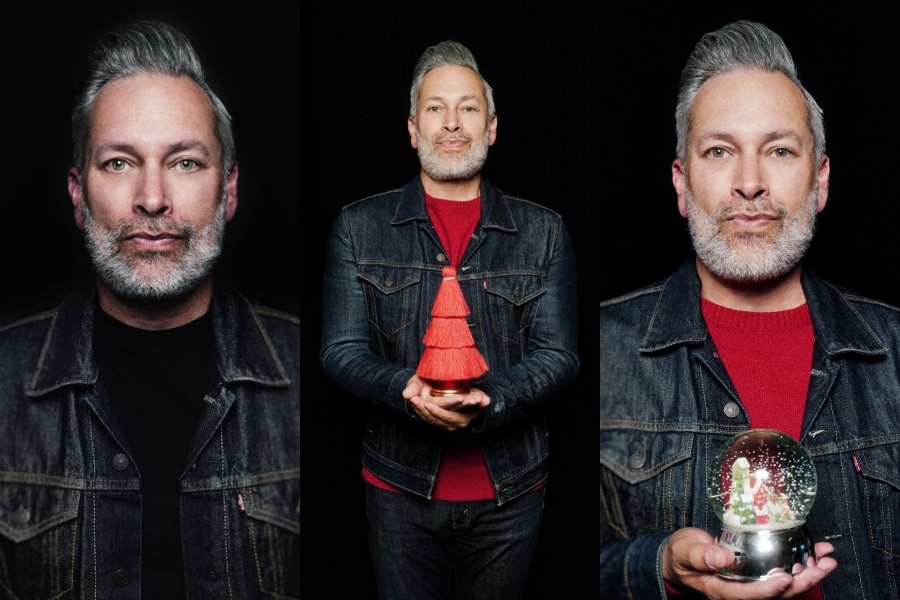
Ronnie Martin has released over 30 full-length albums and EPs of analog synth-pop for over three decades across a variety of monikers. In that time, he’s also released a range of albums overflowing with Christmas music – some are classics and some are his own contributions to the tradition. He truly loves the music of the season. And since I truly love his music, I wanted to talk to him about Christmas music, how he makes it, and what he believes makes a good Christmas song.
Adam P. Newton: You love Christmas. A lot. You start posting about it on social media months in advance. You set up Christmas decorations in your writing and music-making spaces while working on various projects. What lies behind your love for all things Christmas?
Ronnie Martin: It is so hard to say! The best explanation is that it’s something my parents created inadvertently. My dad was a post-depression kid who grew up in LA with parents who struggled to put food on the table, much less provide an extravagant Christmastime. On the other hand, you have my mom who was raised by my divorced grandmother in Jersey, who somehow created a Christmas experience that far exceeded what was possible given their economic status.
When my parents had kids, it was my dad’s desire to provide the Christmas his childhood lacked, and my mom brought her experience to the table to make it happen. Christmas was easily the most anticipated season in our household, so I think the mood and feeling of it just captured my imagination at a young age.
That moment of waking up on Christmas morning was the closest thing to pure magic I’ve ever experienced. I think it’s because of those formative memories that my whole year hinges on Christmas.
APN: Is there a specific Christmas memory, feeling, or inherent bit of nostalgia that you strive to recapture in your music?
RM: You know, Christmas contains these internal “moments” or “feelings” that are hard for me to articulate. The best way I can describe it is a deep sense of longing and joy all mixed together. A happy-sad kind of euphoria. C.S. Lewis has some illuminating ways he describes longing that capture what I’m attempting explain rather poorly. But that’s what I hope to capture in the music.
There is a combination of joyfulness intermingled with melancholy in the lyrics and melodies that’s hopefully an artful fusion of hope, nostalgia, reflection, and wonder. The music is just the vehicle, but it has its own limitations, too.
Personally, I’m content with Christmas music being interpreted by a jazz trio or a string quartet, but that’s not the kind of music I make, so I always feel like I’m not offering the best translation of these songs. But it just happens to be the music I make.
It’s aspirational for me to try and capture the mood of the classic carols and hymns, because I’m not sure if it’s possible. Songs like “Christmas Nostalgia” or “On Christmas Morning” might be the closest I get on Evergreen Melodie.
APN: Take us inside The Holly Haus a bit. What is your process when you begin to write and compose the songs we’ve heard on Evergreen Melodie, Holiday Fable, and other Christmas albums? Are you lyrics first, music first, or follow the spirit of Christmas?
RM: The spirit of Christmas is always the inspiration! The Holly Haus itself is actually the final part of the process.
The songwriting begins on a little upright piano in my house. There’s usually about a 3-week period in the year when all the songs come to me, and I record all the melodies into a little recorder I keep handy. I usually start with a chorus melody and then add to it from there.
I’m usually jotting down ideas for song titles, which I’ll try and fit with some of the chorus melodies. A “keeper” song usually comes together fairly quickly, but I try to be patient because songwriting is my favorite part of the process and I want to make sure I’m giving myself time for the inspiration to finish its course.
When the songs feel ready, I move to The Holly Haus, lay out a simple arrangement–just chords and melodies–and then start programming and recording the synthesizers, one sound at a time. This is the most tedious part, and the one that requires the most hours and intensity. I used to enjoy studio time the least because of how difficult it can be, but I’ve come to enjoy it so much more now.
When the music feels done, I will jot down some lyrics right before I need to record vocals. And that’s the formula. I think of my songwriting like baking–if I use the same ingredients I should get something delicious every time.
APN: As someone who has followed your musical career for over three decades, I could listen to you talk for a long while about synths, Moogs, and more. What is your instrumental and recording setup these days, and how does it differ from Robot Rock, The White Songbook, or even Dwarf Mountain Alphabet? And does the setup differ further when writing holiday songs versus the tunes on Consume Like a Moth What Is Dear?
RM: What’s interesting is that my setup has changed very little over the years! For recording, I use Logic instead of the digital audio recorders I used back in the day, which makes recording and editing so much more streamlined and intuitive. But the way I program and record the analog is the same.
I program each sound from scratch and build the songs up brick by brick. Sometimes I like to lay down a kick drum and bass line to have a solid foundation to work from, but other times I begin by laying down chords so that I can begin arranging things from a more melodic place.
I would say the biggest difference between the holiday tunes and the regular album tunes is that I seem to have a much freer approach with the holiday ones. I’m not as precious about them for some reason, so they come together more intuitively. I take the regular albums a bit more … seriously because they’re deeper, darker, and more complex on an emotional and musical level. I’m aiming for more simplicity with the holiday records.
But the setup? Relatively the same. Very simple, very minimal. Make a sound, record it, repeat.
APN: What makes a good Christmas song? How do you know when you’ve happened upon a lyric or melody you need to use?
RM: The same thing that makes any good song, in my opinion. It will always be about classic chord changes and a beautiful, memorable melodies. Now, I know this is all subjective territory here. But I guess one example would be a song like “Have Yourself A Merry Little Christmas.” It has a very longing, but catchy hook, with a simple, primary chord change underneath.
“The Christmas Waltz” is another good example. These are the kinds of chords and melodies I’ve always been inspired to write, and when you break them down, they all follow a similar pattern. A good example is probably the chorus refrain of “Merry Merry Christmastime for My Baby.” When it begins to loop in my head and surfaces a sense of joy and longing, I know I have a keeper.
APN: Since you’re a pastor and teacher in the Christian faith tradition, some might think that your Christmas albums would be about Jesus, Advent, and other aspects of your religion. Yet, outside of a couple songs on your 2003 album, The Magic of Christmas, you don’t write about those themes. You instead write about what some might call the “secular” elements of the season – and do so with a loving and heartfelt fervor. Could you talk about that a bit?
RM: That’s a fair question! My best answer is that I probably don’t think about it too deeply. If you listen closely, you’ll probably hear subtle touches of Advent themes sprinkled in, but they generally fit more in the category of carols than hymns. I’m trying to tell short, fictional stories, or stories inspired from my past. With that said, we’re dropping an unreleased Christmas single on December 20, 2025 that presents the gospel.
APN: As a fan of Christmas, I imagine that you have a range of playlists that match different moods, tones, and events throughout the season? What would you consider the best modern holiday songs of all time? What are your sentimental favorites that aren’t necessarily “the best?” And what classic hymns and folk songs do you thoroughly enjoy?
RM: Some modern songs I love are “Happy Happy Christmas” by Ingrid Michaelson–timeless hook, like a classic. “Cold December” by Michael Buble–love the energy mixed with the melancholy. “Come On Ring Those Bells” by Evie–a lot of originals on there that evoke my childhood.
I do love sillier holiday tunes like “The Happiest Christmas Tree,” and “Mrs. Santa Claus” by Nat King Cole. My favorite hymns are probably “O Holy Night” and “Angels We Have Heard On High.” I could make a case that “O Holy Night” is the best song ever written, period.
APN: What about full-length albums? What are the records you just HAVE to hear to get into the season?
RM: That list includes:
- The Carpenters – Christmas Portrait
- Nat King Cole – The Christmas Song
- Michael Buble – Christmas
- Dean Martin – The Dean Martin Christmas Album
- Dean Martin – A Winter Romance
- Johnny Mathis – Merry Christmas
- Andy Williams – The Andy Williams Christmas Album
- Seth MacFarlane and Liz Gillies – We Wish You the Merriest
- Amy Grant – Home For Christmas
- Burl Ives – Rudolph the Red Nose Reindeer OST
APN: Since Mariah Carey introduced “All I Want for Christmas Is You” into the world, we haven’t had any truly new songs added to the holiday canon. Everyone seems content to reproduce the classics. Why do you think that is?
RM: There are new songs released every year, but they don’t achieve the timeless quality as the classics, like you said. The well-known tunes came from an era where songwriters composed with a melodic vitality and intent. So, anything new that stands the test of time will need to continue in that tradition, in my opinion.
APN: Who would you love to hear create a Christmas album next?
RM: I keep waiting for Michael Buble to release another one, to be honest!
Editor’s Note: The interview was lightly edited for clarity.
Related