

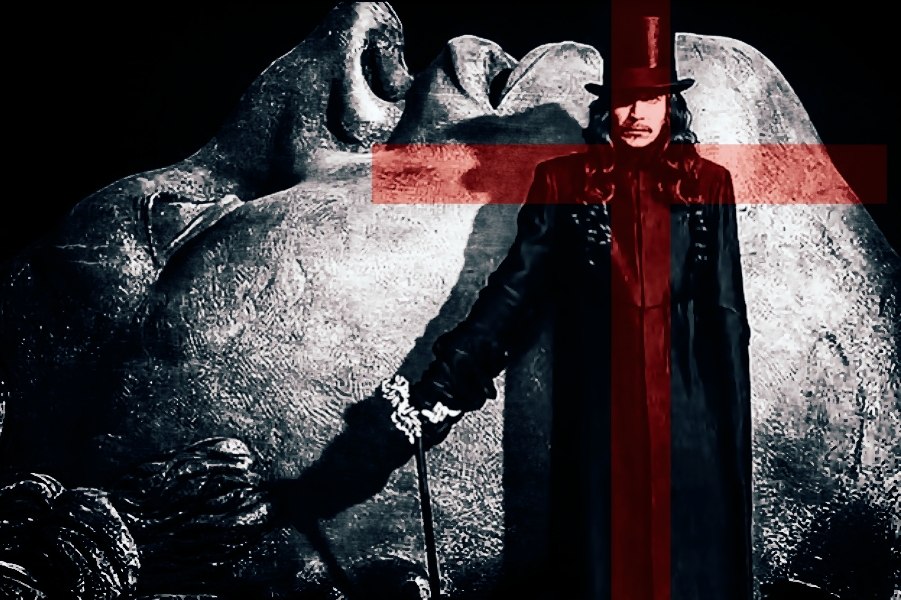

Spooky season is here and with it… well, that depends on who you are. Pumpkin spice enthusiast; ghoul decorator; witchy cosplayer; or anti-fun zealot. Nevertheless, there is one spooky crave that works all year long: that Fang Crave. Vampires are beyond season, beyond understanding, beyond logic. Cinema and Vampires, especially Dracula, have always had a tumultuous relationship. Many think Bela Lugosi’s Dracula (1931) is the first movie to use that name. Interestingly, a Hungarian silent movie, Drakula halála (1921), is the actual first; its title meaning Dracula’s Death. An original story worth your time if you feel inclined to peruse the interwebs.

Still a year later, the aforementioned tumultuous congress birthed Nosferatu (1922); a rip off of Bram Stoker’s Dracula, changing names to escape copyright shenanigans. Coincidentally, the begetter of one of the movies we’ll soon explore.
Since the dawn of cinema, every generation has produced a film starring/involving vampires. Every decade has inflicted their own style/flavor/fashion/messaging into the bloodsuckers too; from ugly despicable monsters to riveting sparkly fuckboys. And that’s just the silver screen; the minute TV showed up, it took the suckers by the fangs and ran– hard.
Our obsession with the macabre comes from our need to confront fear and guilt. What better way to keep fear at bay than embracing it as something alien but fascinating. Turn guilt into a reason not a handicap, and you can escape it by making it a badge. I survived the monster even if every other person around me perished. Then you entwine said fear and guilt into a monster that wants you to be the same and live forever.
DRACULA’S EVOLUTION IS OUR OWN EVOLUTION. HE’S CHANGED WITH US BECAUSE WE CANNOT MOVE FORWARD WITHOUT BRINGING OUR DARKNESS ALONG.
But as with everything, the romanticizing of the monster removes its true merit: the cautionary tale. Forget the mystical aspects of the tale; in its simplest form– the point was to keep you from dwelling in the past. Move forward. Do not destroy (kill) those around you to stay in (wait for) a memory.
The first tales of the bloodsuckers made them monstrous; no sane person would want to look like that. But then some Bword decided to depict them not only as beautiful but enigmatic; caution went downhill from there. Add religious propaganda, using them as avatars for the Devil and parading sexy girlfriends; poor devoted men tempted by fallen women in cahoots with the Evil One.
Still, we’re here for the exploration of bloody cinema as art, even if all art can be exsanguinating propaganda. The discussion ain’t about every vampire in celluloid. Our focus is the granddaddy and usually progenitor of the lot.

BRAM STOKER’S DRACULA (1992)
Deservedly embedded in popular culture, Coppola’s vampire extravaganza holds the title of “only vampire movie ever nominated for an Oscar.” Nevertheless, as with many cult classics, it wasn’t the instant hit we’d think it today. If you give it a moment’s thought, what’s the point of this movie? Don’t get me wrong; many things changed because of it. A big kick to that door keeping the monster movies from becoming prestige events.
BRAM STOKER’S DRACULA WAS DIRECT VISUAL AND THEMATIC INSPIRATION FOR THE INTERVIEW WITH THE VAMPIRE (1994), BASED ON THE BOOK BY ANNE RICE.

Up to its release, many considered vampire movies cheap contrived affairs; are they really horror or just an excuse to be naughty? The hand of Coppola and the weight of the cast turned that notion on its heels. Still, beyond entertainment, what do we get from this film?
Dracula’s origin story according to Coppola might be based on the historical Vlad the Impaler, but it’s an add-on; it has nothing to do with the Stoker’s book. It feels very 2020’s in hindsight, with the current penchant for turning villains into not only misunderstood but relatable individuals. Why couldn’t Dracula just be a messed-up asshole? Yeah, if the non-believers hadn’t invaded the believers’ land this would never have happened. Sigh. You don’t need to put any specific belief to believe that sentence is someone’s reasoning.
I’m laughing my ass off by the six degrees of separation I just mentally gymnastics’d myself into; remove the deity given powers and this film is mostly John Wick (2014) with a splash of reincarnation.
Actually, Mr. Wick as a man driven by vengeance makes more sense than Dracula. The deity he’s fighting for can’t protect the land of his believers; still, somehow, someway, that same entity should “protect” Drac’s wife. Why? Moreover, my boy is so fucking special he renounces his former boss and becomes the opposite side prized hog. Be serious. Had it been Zeus, dude would’ve been struck by lightning right there and then.

COPPOLA TRICKS US INTO THINKING HIS DRACULA IS TELLING US SOMETHING ABOUT GOOD AND EVIL. IT DOESN’T SAY ANYTHING NEW, ONLY LOOKS PRETTY.
A study in contrasts, this film lull us into a false sense of understanding; Mina, the school teacher, the good girl, the faithful fiancée versus wanton Lucy. Jonathan Harker, the working man, the victim of evil versus the suitors: Rich, Rational, and Reckless. Van Helsing and his abundance of knowledge versus his lack of tact. And how can we forget, Dracula “I’ve crossed oceans of time to find you” himself; betrayed by his boss, maligned by the world, but still turning Bwords into his succubuses (succubi, succubae?).
Through Coppola, the vampire becomes a commodity for opulence and excess; a vehicle for the Gothic to embrace the Carnal; an excuse to make the horrible: appealing. Retribution surges as intermediary between good and evil– with Love as the forced hand of Redemption. Never mind that the Count’s powers are more convoluted than those of Imhotep in The Mummy (1999).
Regardless, it turned the tides for the bloodsuckers; they became edgy, fashionable, and above all desirable.

NOSFERATU (2024)
The 1922 original film is a Germanized version of Stoker’s novel. Set in a fictional German port town and basically an emotional response to the horrors of WWI. The silent film thrives in the otherness of the vampire, a weapon against normalcy. Due to its place of origin, people started to see that otherness as an allegory for a specific group. What said people don’t know/forget is that director F.W. Murnau was gay; thus, perhaps a little less inclined to encourage dissent against othered groups. But we’re not here to explore a film premiered more than one hundred years ago. The 2024 remake is our prey, sorry, goal.
NOT NECESSARILY A CHEAP VERSION OF STOKER’S DRACULA BECAUSE IT HAS ITS OWN MERITS, NOSFERATU IS STILL A FLAWED BEAST BY VIRTUE OF THEIR SHARED DNA.
In 2024, the characters speak, but what do they say? What do they add to the vampire mystique? The fall from grace after occultism and echoes of hysteria replace a broken pact.

Why Count Dracula Orlok chose Mina Ellen long before current events? Here, she’s been upgraded from fiancée to Harker Hutter’s wife and suffering from “erratic” spells. Never mind the Count choosing her, explain why a snack like Hutter married the woman. Clearly not a dowry. Their lack of fortune is what prompts him to engage with the eccentric aristocrat in a faraway land.
On his way to the Count, our hero spends the night in an encampment/hostel/touristic attraction. Here we have some foreplay with the otherness the movie embraces. His hosts? Apparently a community of them traveling folks with fortune tellers and exotic dancers, you know the ones. They also seem to moonlight as monster hunters by night. Since there is a young, full-bushed lady on horse, my first thought is: offering for Dracula Orlok. I even credited her with virginity because these offerings seem more about hymen than blood. But nope. The community at large goes to open a casket and stake whatever creepy thing lay within. NO full bush involvement whatsoever.
Continuing with the esoteric theme, Orlok makes Hutter sign a contract in some spidery language. We’ll later discover the document worked as a transfer of ownership for the wife. I’m surprised the filmmakers didn’t involve blood in the transaction. Is this how they’re expanding the lore, with Faustian shenanigans? Moreover, dude doesn’t know what he’s signing, that should invalid that shit even at a metaphysical level.

WE OFTEN FORGET HOW CUMBERSOME TRAVELING WAS IN THE 1800S. STILL DRACULA DOES BECAUSE IT’S FASHIONABLE IN 1897.
Because the source material demands it, we must have the fukken Count on a ship. Never mind that such trip requires Magellan-size chicanery. As per usual, Hutter has the plot armor of a FMC in modern romantacy. He survives a fatal fall to end up in some religious place. Here, mysticism, superstition, and foreign tongues mingle to keep the familiar pattern moving. At the other end of the story, hysterics abound to conjure Dr.Van Helsing Prof. Von Franz.
Beyond its innovative imagery, the 1922 film gave us the sun as the true weapon against Dracula; it still took plot contrivances and womanly trickery to get him there, though. That tenuous psychic connection between the vampire and his prey in the original explodes beyond 11 in 2024. The innovation director Robert Eggers brings to the lore is epileptic episodes as code for hysteria/mental disorders. Also, dudes getting bitten on the chest instead of the neck… What, biting them in the butt was too much? Well, that might’ve happened if Eggers had decided to make the Count hot. Who knows?

DRACULA – A LOVE TALE (2025)
Of The Fifth Element (1999) fame, Luc Besson takes a gander at the father of blood. An amalgamation of Coppola’s Prologue and Nosferatu mishaps give us a new interpretation of an old tale. Besson thinks himself clever by scattering set ups along the way; in reality they are nothing but botched infodumps and misguided foreshadowing.
“God does not perform reincarnation,” the deity’s mouthpiece says as the affronted prince demands his wife back; only to spend 400 years awaiting her return in the same face and hot body.

DIRECTOR BESSON GRABS WHAT HE THINKS IS THE BEST OF DRACULA TO GRAFT HIS OWN TALE, TAINTING THE MYTH AND COMPLICATING THE LORE.
This time, we’re not destined to cloudy England or fictional Germany. We’re going to Paris because this is a French production, goshdarnit. The centennial of the French Revolution is the timeframe for the movie; never mind the shenanigans of the Second Republic and the Second Empire. The one contending with evil is no doctor or professor but a priest; one in a long line of holy men tracking the evolution of the bloodsuckers.
Besson still did interesting things with his version. Here, Dracula is a prince. He already owns property in Paris, this Harker comes to buy instead of sell. The vampires created along the way are actually agents in search the reincarnated wife. Now, that perfume subplot felt a little too close to Ray Winstone’s Dreykov in Black Widow (2021). All kinds of icky.
This would’ve been way more engaging as anything but a vampire story. Any other supernatural being could’ve been a better fit. There’s a cool action movie here, strangled by vampiric hands forcing melodramatic beats. Only in movies people reincarnate in the same exact body and with readily at hand memories of their past lives. That’s not how fucking karma is supposed to work. The film brings nothing new to vampire lore; a mere unprofitable rehash of a tired song. Besson should know better.

VAMPIRES REMAIN CONSEQUENTIAL IN 2025. DRACULA STILL REIGNS AS THEIR GRANDDADDY. THE ONLY PROBLEM IS “SPARKLING” SEEMS TO BE THE LAST INNOVATIVE THING DONE WITH THEM.
We observed three films with close roots to the novel that (whether we like it or not) shaped our understanding of the creature. Vampires offer us a mirror we insist on looking upon without understanding the true purpose of the exercise. All three movies conflate Love and Lust. A desperate need to return to a “perfect” moment in time. The monster (us) becomes feral when what it yearns for becomes imminent. We tend to look at the past with rose-tinted glasses, and nothing stains shit rosier than blood.
