

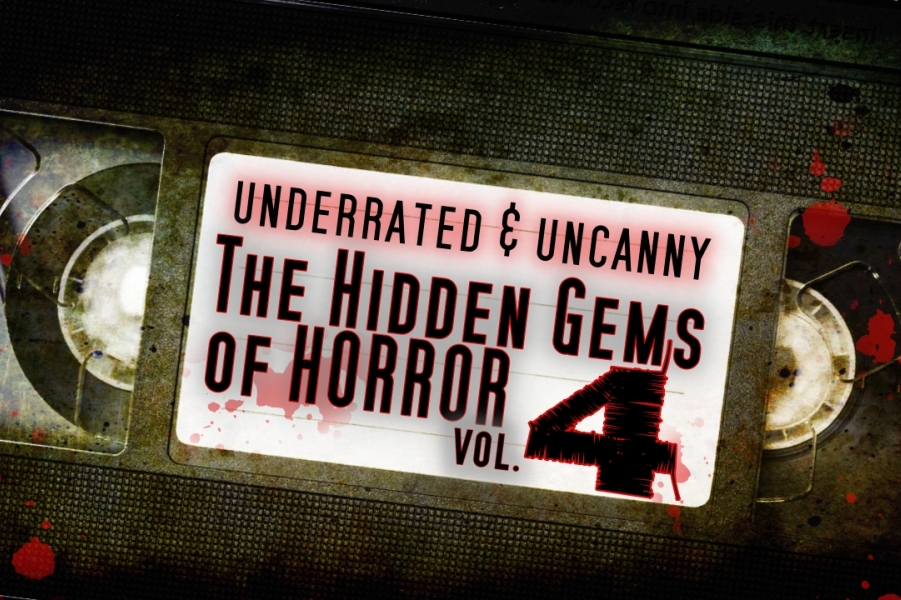

The leaves have turned as yellow as the full moon, orange as jack-o-lanterns, and crimson as the Technicolor blood on your TV. Days have gotten shorter, and the nights are growing colder. Halloween has finally arrived! With this month’s emphasis on all manner of horror-adjacent media, you’re probably burned out on the classics. After all, how many times can you watch Halloween or a Friday The 13th film before those scares don’t hit quite as hard?
Welcome to the Underrated and Uncanny: The Hidden Gems of Horror Vol. 4!
Lucky for you, I’m a trash bin of horror knowledge and a connoisseur of the macabre. I’ve selected a few of my favorite horror movies that people rarely discuss. While these films definitely aren’t the greatest of all time, they are excellent alternatives to your standard spooky fare. Check them out – if you dare!
Intruder (1989)
It’s the overnight shift at a small-town grocery store, and the crew is just trying to make it to sunrise. But as the aisles empty, the chaos ramps up. The co-owners are at each other’s throats over whether the store should even close. A cashier’s abusive ex won’t stop lurking. And to top it off, there’s a shadowy maniac slicing through staff like expired deli meat. By the time the lights flicker, it’s less about clocking out and more about staying alive. Cleanup in aisle 4 just got permanent.
Evil Dead II co-writer and longtime Sam Raimi collaborator, Scott Spiegel, slips into the director’s chair. He expands on a scrappy little short he and Raimi made long before The Evil Dead became legend. The setup is nothing revolutionary, but Spiegel makes it sing with his sharp pacing. Plus, there are genuinely likable characters and a flair for inventive (and often downright weird) camera work. The kills are brutal, but there’s an undeniable affection for the genre pulsing beneath all the carnage. Arriving late to the ’80s slasher boom, Intruder still earns its place as a blood-soaked gem. One made with style, heart, and a clear love for the madness.

Messiah Of Evil (1973)
A young woman travels to a small, remote seaside town to find her estranged father. As she searches for answers, she becomes entangled with a group of drifters on their own mission. But things are not what they seem as she discovers the town harbors a dark, growing menace. The deeper she investigates, the more she is drawn into the unnerving atmosphere of the city and its eerie inhabitants.
Co-written and directed by Willard Huyck and Gloria Katz (acclaimed for their work on American Graffiti, Indiana Jones and the Temple of Doom, and their uncredited polish on Star Wars), Messiah of Evil defies the conventions of traditional horror. Rather than relying on shock or gore, its power lies in an unrelenting atmosphere, tension, and unease. From its opening moments, the film exudes an ancient, subterranean menace that seeps into every frame. Paired with stunning Giallo-inspired cinematography, Messiah of Evil unfolds like a fever dream. It’s disorienting, surreal, and loaded with an existential dread that lingers long after it ends.

Cronos (1992)
Jesus Gris, an aging antique dealer, discovers a 400-year-old mechanical scarab that latches onto him, restoring his youth and vigor. But this newfound vitality comes at a terrible cost: an uncontrollable thirst for blood. As he struggles to cope with his disturbing transformation, a dying tycoon brings danger to Jesus’s doorstep. Now, he must battle the changes in his own body, fend off a relentless pursuer, and protect his orphaned granddaughter.
Despite its seemingly whimsical premise, Cronos delivers a compelling and original spin on vampire mythology. Guillermo del Toro’s feature film debut eschews jump scares for a slow-burning tale rich in atmosphere and emotional weight. Even with a modest budget, the film is packed with striking imagery, including decaying gothic interiors, gold-hued machinery, and a creeping sense of dread soak every frame. It’s dark and unsettling, yet unexpectedly heartfelt, blending horror and humanity in a way few vampire films do. Cronos not only hints at del Toro’s future brilliance but stands as one of the most unique entries in the overstuffed vampire sub-genre.

One Dark Night (1982)
Desperate to ditch her straight-laced image, a nervous teen agrees to spend the night in a mausoleum as a hazing ritual for a high school gang called The Sisters. But things take a deadly turn when an undead psychic vampire rises from the crypt. The girls, as well as the vampire’s estranged daughter, must now work together to survive the night as the real nightmare begins.
Meg Tilly, E.G. Daily, and Adam West in a gothic ’80s ride packed with neon vibes and graveyard grit? Count me in! One Dark Night may be low-budget, but it leans into its style and weirdness with full confidence. It’s more about mood than mayhem, serving up creepy fun instead of the excess found in other horror films of the decade. Director Tom McLoughlin, who later brought Jason Voorhees back to life with a lightning bolt, keeps it slick, sarcastic, and soaked in atmosphere. It’s a strange little gem that knows exactly what it is and doesn’t try to be anything else.

Strait-Jacket (1964)
After returning home early from a business trip, Lucy Harbin (Joan Crawford) discovers her husband has been cheating on her. In a fit of rage, she murders him and his lover while her 10-year-old daughter, Carol, watches in horror. Declared not guilty by reason of insanity, Lucy spends the next two decades in a psychiatric institution. Upon her release, she tries to rehabilitate by moving in with her now-grown daughter on her brother’s quiet farm. But as unsettling events unfold, Lucy and Carol are forced to confront a chilling reality. Is the past repeating itself, or is something far more disturbing at play?
Though helmed by William Castle, the king of camp and gimmicks, Strait-Jacket dials down the schlock in favor of slow-burning psychological horror. With a screenplay by Psycho scribe Robert Bloch, the film leans into themes of madness, trauma, and manipulation with more nuance than you’d expect from an early ’60s thriller. Joan Crawford delivers a performance that’s both unhinged and heartbreakingly human as she brings weight to a character caught between redemption and relapse. While it may not reach the chilling heights of Psycho or the gore of later slashers, Strait-Jacket stands out for its eerie restraint and its surprisingly progressive take on mental health and gaslighting.

Body Snatchers (1993)
A scientist with the EPA relocates his troubled family to a secluded military base to study the impact of environmental toxins. Already strained by a crumbling marriage and a defiant teenage daughter, he soon suspects something far more disturbing: the base’s residents are being quietly replaced by cold, emotionless replicas. As paranoia mounts, he finds himself caught between domestic chaos and a chilling conspiracy rooted deep within the military-industrial complex.
Though it’s the third adaptation of Jack Finney’s 1954 novel, this version of Body Snatchers digs deeper into the human cost of a possible alien takeover. It offers a more intimate and unsettling look at the collapse of identity and trust. While it embraces the classic sci-fi paranoia that defines the genre, what sets it apart is its unapologetically bleak tone. By 1993, the myth of the American Dream was already fading, but Body Snatchers doesn’t just acknowledge its death; it exhumes the corpse and spits on it. The film dares to suggest that humanity may not be worth saving, as if we’re neither morally equipped nor collectively willing to earn the peace we crave. Despite being dismissed as mediocre upon its release, Body Snatchers feels more relevant today than ever.

Splinter (2008)
During a stop at a remote gas station, a young couple gets carjacked and taken hostage. As they try to escape, they find themselves under siege by something worse: a parasite-like creature that infects and reanimates its victims with brutal efficiency. Trapped and hunted, the couple and their unlikely group of survivors must set aside their differences and find a way to survive before the thing outside gets in.
The early to mid-2000s weren’t exactly a golden age for horror. The genre was stuck in the creative slump that followed the Scream meta-wave, the found footage craze, and the brief obsession with J-horror. Splinter breaks that mold by channeling the claustrophobic paranoia of John Carpenter’s The Thing. It thrives on a tight, single-location setup and a relentless sense of dread, sharp writing, and compelling characters. And we can’t forget the genuinely inventive creature design! What could’ve been a forgettable low-budget flick turned a lean, tense, and surprisingly effective monster movie!

Torso (1973)
A masked serial killer with twisted psycho-sexual urges is stalking female college students before viciously cutting their bodies into pieces. Unfortunately, the police are baffled, as the only piece of evidence is a black-and-red scarf. When a wealthy student recognizes the clothing item and suspects someone close to her, she becomes the next target. Fleeing to her family’s isolated cliffside villa, she soon realizes the killer may be closer than any of them think.
As an early ’70s giallo, Torso checks all the expected boxes: gratuitous nudity, a silent killer in black leather gloves, and a streak of misogyny aimed at the victims. But here, these elements aren’t just window dressing but integral to the twisted narrative. The film’s first half plays like a proto-American slasher, reveling in sex and gore. However, the third act shifts gears into a nerve-shredding cat-and-mouse game, as one woman finds herself trapped in a house with the killer. Stylishly shot and tightly directed, Torso delivers a gripping blend of suspense, sleaze, and striking visual flair.

Curse Of The Demon (1957)
American professor John Holden arrives in London for a parapsychology conference, only to learn that his colleague has died under mysterious circumstances. Soon, he’s drawn into the orbit of Julian Karswell, a charming but sinister cult leader with ties to alleged Satan worship. As a staunch skeptic, Holden clings to his scientific beliefs, but reality begins to unravel. He later finds himself not just questioning the supernatural but his own sanity.
At first glance, Curse of the Demon might seem like standard B-movie fare, but it’s not exactly what you’d expect. Played with complete seriousness, the film trades cheap thrills for a slow-building sense of dread. By diving into themes of science versus the supernatural and the allure of the occult, the film is driven by the chilling presence of Satan worship. While it opens and closes with brief glimpses of monster-movie spectacle, the core of the film is steeped in psychological tension and creeping unease. With moody cinematography and gothic set pieces, Curse of the Demon conjures a sinister atmosphere that lingers long after its relatively short runtime. It’s far more intelligent and unsettling than you’d ever expect from a 1957 horror film.

Cure (1997)
Detective Kenichi Takabe and psychiatrist Shin Sakuma are drawn into a disturbing series of murders, each more brutal than the last. The killers are ordinary people with no apparent motive or memory of the crime. The only common thread is an enigmatic psychology student named Mamiya. As Takabe and Sakuma dig deeper, they find themselves entangled in a web of psychological manipulation and inexplicable behavior that defies logic. The closer they get to the truth, the more the lines between sanity and madness begin to blur. With the case going nowhere and Takabe’s personal life crumbling, he’s haunted by a growing suspicion that something far more sinister than murder is at play.
Cure is a masterclass in atmospheric horror, meticulously designed to pull viewers into a space that hovers somewhere between waking nightmare and quiet paranoia. From the clinical detachment of crime scene investigations to the eerie monotony of suspect interrogations, every scene pulses with a subtle, almost imperceptible repetition. Director Kiyoshi Kurosawa wields these elements with surgical precision, crafting a film that refuses to offer easy answers. Instead, Cure burrows deep into the psychological shadows where fear is born from ambiguity. The horror here lies in the slow, inescapable realization that the mind can be manipulated in ways we cannot fully understand.
