

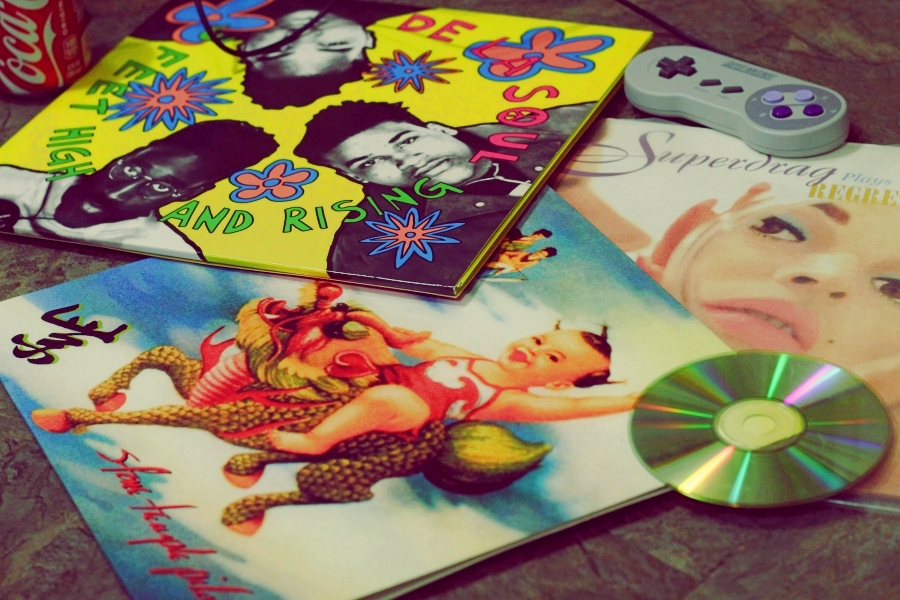

When you think back to certain moments in your life, it’s not always the details you remember. It might be the soundtrack. And most of the time, that memory is louder than it was – thanks to nostalgia.
A guitar cutting through a humid crowd in a sweaty show at a dive. The buzz of a fluorescent parking lot light. The sticky heat of a July afternoon, where every song felt like an incantation. At seventeen, I didn’t know what I was doing most of the time, but I knew how it felt to scream along to In The Valley of Dying Stars with my Walkman at maxed-out volume. Being blown away by how Reign In Blood was on both A and B sides on the cassette. I remember Fantastic Planet echoing from scratchy headphones.
These weren’t history-making events. They were small, messy, imperfect. And yet, they define how I feel about that time in my life. That’s what nostalgia does. It edits, exaggerates, and builds a myth out of ordinary life, often one song at a time. Man, that’s kinda corny, isn’t it?
Nostalgia is more about emotion than accuracy
Cognitive science has a term for this. They call it rosy retrospection. Our brains hold onto feelings as opposed to storing events in a video archive. The euphoric nights last while the fights and awkward silences fade. Evolution wired us this way. Positive reinforcement is more useful than dwelling on pain. Feeling good increases survival odds. Music works this way. It fuses sound and reward, encoding experiences in a way that makes them unforgettable.
On the other side of that is the reminiscence bump. Studies show that, between the ages of 10 and 30, people form disproportionately more lasting memories than at any other stage of life. Our brains are wiring themselves during those years. From identity to social bonds, it’s all about the peaks of emotional intensity. Every concert, mixtape, or inside joke is etched into the brain. That’s why the music from your adolescence feels eternal. It isn’t objectively better; it’s kinda just louder. Neurologically anyway.

Memory isn’t a fixed object.
Think of it more like a film that gets re-edited every time we press play. Each time we recall an event, we reconstruct it based on who and where we are, and what emotions we carry in the present. Seventeen-year-old you is always filtered through today’s you. That walk in 1998 with Around The Fur blasting in your headphones wasn’t as cinematic, despite what your brain insists in 2025. At the time, you were probably anxious, broke, and covered in acne. But the memory has been rewritten as something purer, brighter, more meaningful.
Doesn’t that explain that inexpressible, intoxicating feeling nostalgia gives? It’s less about the truth of what happened and more about how the story has been retold with romanticized highs. Can you imagine spending the rest of your life with the person from your first date? I’m not saying it hasn’t happened, but I sure don’t want to think about it, at least not in my case!
This bias shapes how we remember AND how we judge what’s happening right now.
Think about a time you spent an entire day at a music festival. In the moment, you’re sunburned, sweaty, and annoyed that Dave Grohl did more belching and introducing band members than playing “Monkey Wrench” without interruption. Later, when you tell the story (or in my case, write the article), it’s a highlight reel of how cool it was to see all your favorite bands in a single day. Psychologists have shown that people report more happiness recalling those events than actively experiencing them. Time edits out the mess.
Applying that to music, it works the same way. A new song from 2025 might feel disposable compared to your teenage anthems. But give it fifteen years, and your brain will have edited, polished, and reattached it to some vivid memory. Suddenly, that random track you half-liked a few years ago will feel like a time capsule. I remember hating The Weeknd’s “Save Your Tears” when it was everywhere, but recently hearing it at Macy’s while buying new jeans had me sort of humming along to it.

Why does music hold this unique power? Because of how deeply it’s wired into the brain. When you hear a familiar song, your brain lights up like a Christmas tree, and dopamine spikes. You don’t just remember the song; you feel it again. That’s how “MakeDamnSure” can transport you back to a cramped car full of your friends on your way home from Six Flags in 2006. It’s not metaphorical; it’s biological.
Nostalgia isn’t just personal; it shapes culture, too.
YouGov polled over 17,000 people about what they thought was the best decade for music. The results consistently show that people rate their teenage years as the best. Baby Boomers swear by The Beatles and Zeppelin. Gen X clings to Nirvana and Metallica. Millennials often crown My Chemical Romance and Radiohead. Gen Z will probably defend Olivia Rodrigo and Sabrina Carpenter with the same ferocity. (Do kids even listen to music anymore?)
It’s not that one era was superior. It’s that each generation’s peak music years overlap with their reminiscence bump. Adolescence wires novelty-seeking and emotional bonding into the brain more intensely than at any other time. So when people declare, “Music was better back then,” they’re really saying, “Music was better when my brain was 17.”
Nostalgia bias fuels a larger illusion: Declinism, the belief that society, morality, and culture are always in decline.
Look back at old newspapers and reports from the ’50s and ’60s, and you’ll find the same complaints: kids are too wild, music is too crude, values are collapsing. Every generation thinks the next is doomed. Yet hard data often shows the opposite. Violent crime in the U.S. is lower now than it was in the ’70s, ’80s, and ’90s. Life expectancy and education have improved. (I mean, as I write this essay, genocide is still happening in Gaza, and N@zism is being normalized in pop culture.) But musically, more genres and voices are thriving than ever before. Hell, major labels are essentially a thing of the past since there’s no MTV and no one listens to the radio. They can’t tell us what to listen to because we’re no longer tuned in and have more options for listening.
However, declinism persists because memory makes the past glow while the present feels incomplete and unedited. At the risk of leaning into politics, nostalgia can also be weaponized, as we’ve seen with the “Make America Great Again” movement. The promise of a return to the “good ol’ days” can be tantalizing. But when we take a step back and realize that America hasn’t always been great, we can recognize and appreciate the incredible highs, while realizing that it’s next to impossible to ignore the painfully dark lows.
Nostalgia isn’t false. It’s just curated.
Understanding the science enables us to embrace nostalgia without being misled by it. We can love our teenage anthems, blast them in the car, and feel seventeen again. We can also recognize that music today is just as vital as we wait for time to sculpt it into memory. I know what you’re thinking: Yes, I do, in fact, enjoy dunking hit songs on my year-end Worst Songs list. But even then, it’s mostly at the expense of myself by actively seeking out mainstream music not marketed to my demographic.

I’m not saying nostalgia is bad (or good, for that matter), I’m just saying it’s a brain function or a filter. For some, it’s a survival mechanism. It lets us turn sticky floors and cruddy basements into cathedrals. Nostalgia can keep us connected, motivated, and creative, just as much as it can deceive us and make us long for a past that never really existed. Ever wonder how Stranger Things is so popular with a generation that wasn’t even born until the late ’90s or after?
The science is clear: The present will eventually glow, too.
The songs you’re streaming right now (even the ones that feel disposable) are already being catalogued, waiting to be polished by memory. Admittedly, I’ve always been anti-nostalgia. Not in a hipster way, but because I prefer the momentum of exploration. Why listen to the same record 200 times when I could listen to 199 other records? It’s not that I don’t appreciate a stone-cold classic, but something about living in the past depresses me. With that said, I also believe that to everything, there is a season (turn, turn, turn).
Put on a record from your teenage years. Feel the superficial rush. I totally get it. Things are BAD right now, and you deserve any kind of retreat. But don’t mistake the trick for the truth. The best music of your life wasn’t the best music ever. It was simply the soundtrack to when your brain was on fire with youth, novelty, and connection. Maybe decades from now, when you hear a song from 2025, you’ll feel young again. Or maybe you’ll think back even further to when you thought you knew it all, but you were painfully mistaken. Either way, you’ll understand. Memory is the real producer, and nostalgia is the mix. But no matter how you shake it, music will always be moving forward. With or without you.
Nostalgic photography by Aaron Cooper