

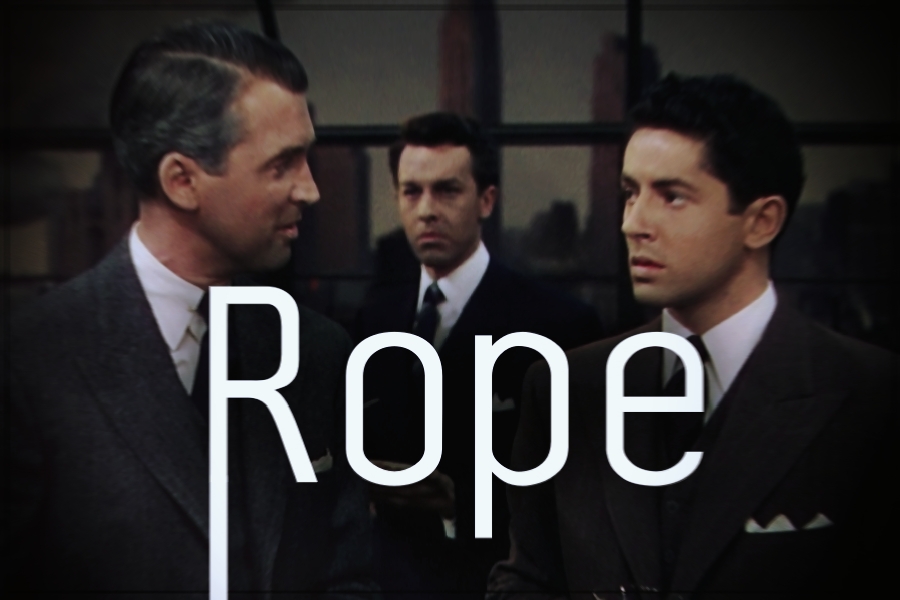

This month, Old Academy Anew explores one of Alfred Hitchcock’s darker pieces: Rope. Rarely mentioned and with questionable undertones for the modern era, this film addresses things we would rather not think about. So get ready for a ride more disturbing than bumpy, and let’s see what this 1948 movie tells you about 2025.
Disclaimer: As I start, a massive rant isn’t foreseeable, but you never know; I might get riled up when the comparison between timelines begins. There’s always swearing, so the “caution sign” for that one is unnecessary.
CAN YOU?
We open to a couple of minutes of credits with a mostly empty, seemingly upper-class street as background. The score deceptively evokes mid-morning pastoral scenery; perhaps some sheep grazing languidly somewhere. Mr. Hitchcock’s name is the last words we see before the camera pans toward windows, their curtains drawn. We hear a scream. A murder is in progress.

One of the murderers checks the victim for heartbeats; assured their prey is gone, they toss him into a big chest conveniently empty for the occasion. Both pant over the closed lid, clearly not due to physical exertion but in “shit we actually did it” awe. Brandon (John Dall), the taller of the killer duo, turns a lamp on. His companion, Phillip (Farley Granger), produces a trembling, “Don’t.” The room returns to its semidarkness.
Brandon fishes for his cigarette case in his jacket, lights one, and after a big drag turns to the other. “Phillip, we don’t have much time.” He looks about the room. “It’s the darkness that’s got you down. Nobody ever feels really safe in the dark.” More nonsensical words of encouragement (?) come out of his mouth as he moves to open the curtains.
IN ROPE, MURDER AIN’T THE MYSTERY BUT THE CATALYST TO THIS EXPLORATION OF HUMAN NATURE.
Hunched atop the chest full of corpse, Phillip seems to come alive as thick curtains recede. Light invades the room. A magnificent view of NYC skyscrapers in this late afternoon graces the screen. The room becomes brighter, but Phillip’s body language still screams perplexed fear.
Brandon removes his leather gloves as he reaches Phillip, pulling off the other’s too. Wringing the gloves into a ball, Brandon pushes them to Phillip, telling him where to hide them. Chekov’s gloves? Perhaps. We’re not there yet.
Gloves away, Brandon begins to tidy the room. He finds a crystal glass and raises it to his face. “It a museum piece now.” He begins to wipe it. “We should really reserve it for posterity. Except it’s such a good crystal and I hate to break up the set.” Admiring it some more, he adds, “Out of this, David Kentley had his last drink.” Oblivious to his friend’s musings, Phillip only stares at the chest; perhaps expecting David to jump out of it and strangle them in return. Brandon comments on David’s out-of-character last drink: whiskey.
Eyes glued to the chest, Phillip utters, “also out of character for him to be murdered too.”
Brandon chuckles. “Yes. Wasn’t it? Good Americans usually die young on the battlefield, don’t they?” Another drag of his cigarette. “The Davids of this world merely occupy space. Which is why he was the perfect victim for the perfect murder.” He shrugs. “Of course he, ah–. He was a Harvard undergraduate.” A jolly sigh emerges. “That might make it justifiable homicide.”
BRANDON AND PHILLIP’S CONTRASTING POST-KILLING BEHAVIOR WILL NOT ONLY PERMEATE ROPE BUT REMAIN WITH YOU LONG AFTER THE MOVIE ENDS.

“He’s dead, and we killed him, but he’s still here.” Phillip’s voice trembles, but his eyes remain unwavering on the chest. Visibly irritated, Brandon offers, “In less than eight hours, he’ll be resting gently but firmly at the bottom of a lake.” “Meanwhile, he’s here,” Phillip retorts, reaching the chest and jerking a lock we can only hear but not see. He cries, “It’s not locked!” Beside him, Brandon basically cheers with relish, “All the better. It’s much more dangerous. Anyway, the lock’s too old. It won’t work.”
They verbally spar. Phillip wishes the body wasn’t there; that it’d been a different victim. Brandon emphasizes it’s a bit late for that and wonders who should have been the victim instead. A tense stare down ensues. “You perhaps,” Phillip growls. “You frighten me.” Even more resolute. “You always have.”
Brandon doesn’t react; his eyes just train on his friend until the other crumbles, saying he was joking and invokes a drink. Agreeing, Brandon whips up champagne to celebrate the occasion. Phillip questions the already cold champagne. Brandon talks, as he always does, until he arrives at an intriguing point. “I’ve always wished for more artistic talent. Well, murder can be an art too. The power to kill can be just as satisfying as the power to create.” He finds two glasses while rambling. “We’ve killed for the sake of danger and for the sake of killing. We’re alive. Truly and wonderfully alive.”
Those celebratory drinks are poured. Phillip assures Brandon he’s not afraid anymore; he’s ready for the next phase of their art installation.
IF WE GO FREUDIAN WITH THIS EARLY SUBTEXT IN ROPE, OUR TWO PROTAGONISTS JUST CAME DOWN FROM A VERY SATISFYING THREESOME.
Heartless fucks. The art installation bit is mine; the movie never uses that term. But these wackos call murder their masterpiece, so why not bring it to this century’s ideas?
Making the impromptu coffin the center of the installation wasn’t part of the original plan. A mere spur of the moment; an extraordinary little bow for the perfect gift to welcome David’s parents to the upcoming get-together.

WOULD YOU?
You might be wondering why I’m transcribing so much dialogue when I rarely do that. I want you to be in the headspace of these two fukkos. Luckily, we’ll soon find out how they landed on such a jaded landscape.
The first person to break the intimacy of our murderers is their housekeeper. She’s surprised the lovely table she set for the party’s been moved; the old chest in the middle of the living room strikes her as a choice in poor taste, peculiar. Brandon’s response? “On the contrary, I think it suggest a ceremonial altar.” He smiles devilishly and adds, “Which you can heap with the foods for our sacrificial feast.” The psycho fucker.
Next to arrive is Kenneth; a friend from school and David’s former rival for the love of the third person to appear, Jane. The intricacies of their liaisons are discussed at length; we can’t afford flashbacks or wasting time with mental acrobatics when infodumps are at hand.
AS OFTEN HAPPENED IN THE EARLY DAYS OF CINEMA, ROPE IS LIFTED STRAIGHT FROM A PLAY, AND THAT DNA’S CLEAR IN MANY OF ITS VISUAL CHOICES.
We learn stuff that we store for later. The one thing that is annoying the hell out of me is how people are in each other’s space; their faces are usually too annoyingly close for comfort. At first I thought it was Hitchcock’s subtle way of imply a larger intimacy between Brandon and Phillip. Nevertheless, as the guests show up, we accept that ain’t the case.
After Jane came David’s parents. Instead of his mother, a visiting aunt comes along. The mother’s allegedly under the weather. Probably can’t stand her annoying sister-in-law and send her away to be other people’s problem. This ain’t told but shown every time the aunt opens her thin-lipped trap. To further disgrace this unwanted lady, she’s nearsighted and confuses Kenneth with David, prompting Phillip to break the glass he holds in startled response. The wound looks mighty awful, but don’t worry about it; Hitchcock makes it disappear in a scene or two.

David’s father asks Brandon, “Is David here?” This makes zero sense in context because he’s seeing all the people currently at the place, unless David is jacking off in some other room. Still, the idea is to let us see how Brandon will skirt the question without outright lying. As people gather, Brandon has been dropping hints, twisting words, and implying things.
WE know why he’s saying things in a certain way while his guests have no clue. But our host doesn’t come with a clever turn of phrase; he simply says, “I thought David was coming with you.” The thing Brandon didn’t foresee was David talking to his father. Mr. Father knows David was supposed to be there before they arrived. Dun. Dun. Dun.
ROPE USES WHAT YOU’VE LEARN TO FUEL YOUR EXPECTATIONS, ONLY TO TURN THEM AROUND AGAINST YOU.
Meanwhile, in a different corner of the party, Aunty Nearsighted happens to be an amateur astrologer. Sure, why the fuck no? She tells Phillip about his zodiac sign, Cancer. Shout out to all them early July babies. Then does a thing that has nothing to do with astrology, but people often put hand in hand; all puns intended because she reads his palm. Can’t see for shit, but she’s being grabby to this young man… Her final verdict: “These hands will bring you great fame.”
The camera focuses on Phillip’s not-wounded hands for several heartbeats; it moves upward and closes in on his shocked face. He might have said he wasn’t afraid earlier, but it’s all a lie. A boiling cauldron of nerves is all he’s been since David got dumped into that chest. He turns to the piano and starts playing, hopefully to calm himself down.

Unannounced, the final guest appears; the only guest that matters to our murderers is finally here. A man who imparted deep nuggets of wisdom with Brandon at his feet. Pearls like, “Murder is a crime for most men, but a privilege for the few.” And I’m gonna stop right here because I want you to find the time to watch this movie.
SHOULD YOU?
Funny how the ones forced to be the smart ones to infiltrate the system have become the idiots now that they have control over it. For decades, people outside the norm had to camouflage themselves to survive. We had to disguise ourselves and operate under the conditions established by the majority. Resourcefulness and subversion became our standards. Now, any leeway we gained turned us into laz,y petulant children, thinking that slamming labels on shit will force others to accept what we create.
Can Alfred Hitchcock’s Rope have a 2020s remake? Of course not. It doesn’t even deserve an F-word to adorn that statement.
ROPE IS A STORY ABOUT POWER THAT DOESN’T NEED GENDER, RACE, OR RELIGIOUS BELIEFS TO SPICE IT UP.

Hollywood’s forgotten how to concoct a story without abusing these spices. The 1948 film has eight actors, five men and three women. All seemingly from the same social class and visually Caucasian, even though Phillip might be the precursor of the ambiguously ethnic sidekick, one of its prime examples being Sal Mineo in Rebel Without a Cause (1955).
To even the genders out, Kenneth would become Kenya; Jane would be bicurious at minimum to keep the tension between Kenya and David, the murder victim. I can also see them gender-swapping David; so, the two assholes, who certainly remain white, not only killed a person for no logical reason, but IT WAS A WOMAN. Let me get my bingo card out and add situations to this reassembled victim. She isn’t only ethnically diverse, but sexually experimental; possesses some physical handicap and an undefinable percentage of neurodivergence. The more labels you have the more important you are, according to Tinsel Town’s latest (clearly rigged) poll.
It took me all of three minutes to think about these things. That’s exactly the same amount of time and effort current Hollywood seems to put in what they churn out. Brandon and Phillip didn’t kill David because he did something to them; they did it to see if they could get away with it. Obviously more complicated than that, but it’s exactly the inciting incident.
EVERY HUMAN IS CAPABLE OF EVIL. JUST WATCH THE NEWS. ROPE AIN’T AFRAID TO MAKE YOU QUESTION YOUR SELF-CONTROL
Arthur Laurents, the screenwriter, and Farley Granger (Phillip) had commented on Rope being a gay story. I can see how some people might perceive it that way; still, what about the killers being gay makes the story different? The film plays exactly the same if it’s two brothers, two sisters, or two female friends. David wasn’t blackmailing Phillip and Brandon. No one is questioning their friendship or closeness. Their housekeeper seems to dote on Phillip without any animosity toward them.

Whether the killers were bumping uglies or not changes nothing. We see what we want to see; sometimes we find patterns that don’t exist or need to be there.
Fun fact: The actors playing similar-looking David and Kenneth both have Dick in their names; one as a proper name, the other as a last name. So technically, the two men vying for Jane were dicks in real life.
8 out of 10. The ending will surely meet your expectations; mine were more complicated.
Rope is freely available at The Internet Archive (archive.org)
